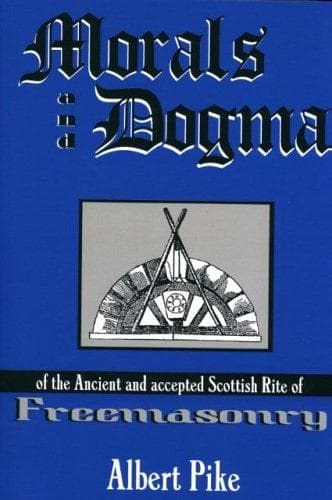
Morals and Dogma of the Ancient and Accepted Scottish Rite of FreemasonryPike, Albert
Religion
Morals and Dogma of the Ancient and Accepted Scottish Rite of Freemasonry
Pike, Albert
Freemasons
EIGHT is the first cube, that of _two_. NINE is the square of _three_,
and represented by the triple triangle.
TEN includes all the other numbers. It is especially _seven_ and
_three_; and is called the number of perfection. Pythagoras represented
it by the TETRACTYS, which had many mystic meanings. This symbol is
sometimes composed of dots or points, sometimes of commas or yōds, and
in the Kabalah, of the letters of the name of Deity. It is thus
arranged:
,
, ,
, , ,
, , , ,
The Patriarchs from Adam to Noah, inclusive, are _ten_ in number, and
the same number is that of the Commandments.
TWELVE is the number of the lines of equal length that form a cube. It
is the number of the months, the tribes, and the apostles; of the oxen
under the Brazen Sea, of the stones on the breast-plate of the high
priest.
III.
THE MASTER.
To understand literally the symbols and allegories of Oriental books as
to ante-historical matters, is willfully to close our eyes against the
Light. To translate the symbols into the trivial and commonplace, is the
blundering of mediocrity.
_All_ religious expression is symbolism; since we can _describe_ only
what we _see_, and the true objects of religion are THE SEEN. The
earliest instruments of education were symbols; and they and all other
religious forms differed and still differ according to external
circumstances and imagery, and according to differences of knowledge and
mental cultivation. All language is symbolic, so far as it is applied to
mental and spiritual phenomena and action. All _words_ have, primarily,
a _material_ sense, however they may afterward get, for the ignorant, a
spiritual _non_-sense. "To retract," for example, is to _draw back_, and
when applied to a _statement_, is symbolic, as much so as a picture of
an arm drawn back, to express the same thing, would be. The very word
"_spirit_" means "_breath,_" from the Latin verb _, breathe_.
Public-domain text, read in full here on John Shaqi.
Reviews
Reviews
No reviews yet
Be the first to share your thoughts on this work.
Elsewhere in the archive
Join the Discussion
Join the discussion
Sign in to leave a comment or review.
Sign InorCreate an account