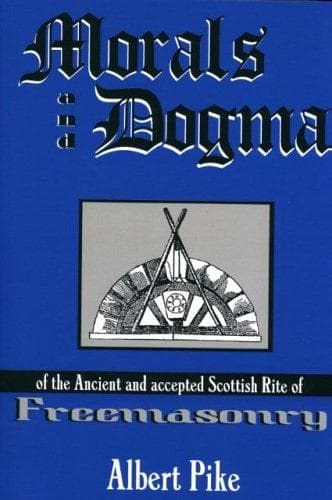
Morals and Dogma of the Ancient and Accepted Scottish Rite of FreemasonryPike, Albert
Religion
Morals and Dogma of the Ancient and Accepted Scottish Rite of Freemasonry
Pike, Albert
Freemasons
To present a visible symbol to the eye of another is not necessarily to
inform him of the meaning which that symbol has to you. Hence the
philosopher soon superadded to the symbols explanations addressed to the
ear, susceptible of more precision, but less effective and impressive
than the painted or sculptured forms which he endeavored to explain. Out
of these explanations grew by degrees a variety of narrations, whose
true object and meaning were gradually forgotten, or lost in
contradictions and incongruities. And when these were abandoned, and
Philosophy resorted to definitions and formulas, its language was but a
more complicated symbolism, attempting in the dark to grapple with and
picture ideas impossible to be expressed. For as with the visible
symbol, so with the word: to utter it to you does not inform you of the
_exact_ meaning which it has to _me_; and thus religion and philosophy
became to a great extent disputes as to the meaning of words. The most
abstract expression for DEITY, which language can supply, is but a
_sign_ or _symbol_ for an object beyond our comprehension, and not more
truthful and adequate than the images of OSIRIS and VISHNU, or their
names, except as being less sensuous and explicit. We avoid sensuousness
only by resorting to simple negation. We come at last to define spirit
by saying that it is not matter. Spirit is--spirit.
A single example of the symbolism of _words_ will indicate to you one
branch of Masonic study. We find in the English Rite this phrase: "I
will always _hail_, ever conceal, and never reveal;" and in the
Catechism, these:
Q.'. "_I hail_."
A.'. "_I conceal_;"
and ignorance, misunderstanding the word "_hail_," has interpolated the
phrase, "From whence do you _hail_?"
But the word is really "_hele_," from the Anglo-Saxon verb Ðelan,
_helan_, to _cover, hide_, or _conceal_. And this word is rendered by
the Latin verb _tegere_, to _cover_ or _roof over_. "That ye fro me no
thynge woll hele," says Gower. "They _hele_ fro me no priuyte," says the
Romaunt of the Rose. "To _heal_ a house," is a common phrase in Sussex;
and in the west of England, he that covers a house with slates is called
a _Healer_. Wherefore, to "_heal_" means the same thing as to
"_tile_,"--itself symbolic, as meaning, primarily, to _cover_ a house
with _tiles_,--and means to _cover, hide_, or _conceal_. Thus language
too is symbolism, and words are as much misunderstood and misused as
more material symbols are.
Public-domain text, read in full here on John Shaqi.
Reviews
Reviews
No reviews yet
Be the first to share your thoughts on this work.
Elsewhere in the archive
Join the Discussion
Join the discussion
Sign in to leave a comment or review.
Sign InorCreate an account