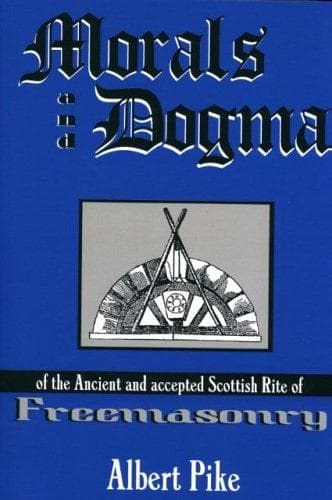
Morals and Dogma of the Ancient and Accepted Scottish Rite of FreemasonryPike, Albert
Religion
Morals and Dogma of the Ancient and Accepted Scottish Rite of Freemasonry
Pike, Albert
Freemasons
All the true Initiates have recognized the usefulness of toil and
sorrow. "Sorrow," says a German poet, "is the dog of that unknown
shepherd who guides the flock of men." To learn to suffer, to learn to
die, is the discipline of Eternity, the immortal Novitiate.
The allegorical picture of Cebes, in which the Divine Comedy of Dante
was sketched in Plato's time, the description whereof has been preserved
for us, and which many painters of the middle age have reproduced by
this description, is a monument at once philosophical and magical. It is
a most complete moral synthesis, and at the same time the most audacious
demonstration ever given of the Grand Arcanum, of that secret whose
revelation would overturn Earth and Heaven. Let no one expect us to give
them its explanation! He who passes behind the veil that hides this
mystery, understands that it is in its very nature inexplicable, and
that it is death to those who win it by surprise, as well as to him who
reveals it.
This secret is the Royalty of the Sages, the Crown of the Initiate whom
we see redescend victorious from the summit of Trials, in the fine
allegory of Cebes. The Grand Arcanum makes him master of gold and the
light, which are at bottom the same thing, he has solved the problem of
the quadrature of the circle, he directs the perpetual movement, and he
possesses the philosophical stone. Here the Adepts will understand us.
There is neither interruption in the toil of nature, nor gap in her
work. The Harmonies of Heaven correspond to those of Earth, and the
Eternal Life accomplishes its evolutions in accordance with the same
laws as the life of a dog. "God has arranged all things by weight,
number, and measure," says the Bible; and this luminous doctrine was
also that of Plato.
Humanity has never really had but one religion and one worship. This
universal light has had its uncertain mirages, its deceitful
reflections, and its shadows; but always, after the nights of Error, we
see it reappear, one and pure like the Sun.
The magnificences of worship are the life of religion, and if Christ
wishes poor ministers, His Sovereign Divinity does not wish paltry
altars. Some Protestants have not comprehended that worship is a
teaching, and that we must not create in the imagination of the
multitude a mean or miserable God. Those oratories that resemble
poorly-furnished offices or inns, and those worthy ministers clad like
notaries or lawyer's clerks, do they not necessarily cause religion to
be regarded as a mere puritanic formality, and God as a Justice of the
Peace?
Public-domain text, read in full here on John Shaqi.
Reviews
Reviews
No reviews yet
Be the first to share your thoughts on this work.
Elsewhere in the archive
Join the Discussion
Join the discussion
Sign in to leave a comment or review.
Sign InorCreate an account