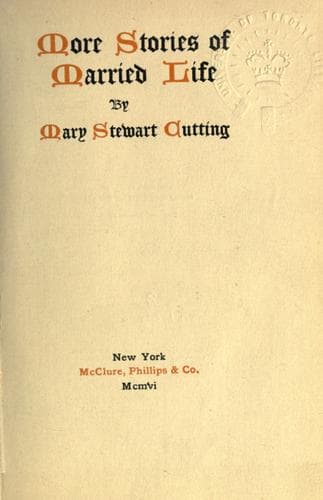
Married people -- United States -- Fiction; United States -- Social life and customs -- 20th century -- Fiction
Tina, indeed, was in that stage of rebellion at life in which she could
see no meaning in any law of her elders; her young desire controverted
all their worldly experience. What was the use of saying she couldn’t
want to do things when she patently did? Refusal hardened her; reason
was only that which darkeneth understanding. She resented any appeal to
her affection, not because she had little, but because she had so much
that she fought being mastered by it, and thrown into those hated fits
of weeping and contrition. She stormily wanted what she wanted. Yet if
she were left untrammelled she showed unexpected glimpses of a heart
passionately loving and tender; an undercurrent as old as the world, as
deep as life, profoundly affecting. Tina was the only one of the family
who had “temperament,” a fact dimly perceived only in the desire to
shield the child from something unknown. At present there was the uneasy
feeling that this something might be a youthful attachment for Francis
Fanshawe.
To the critical eye, young Fanshawe, an orphan, was simply a stolid
and uninteresting young fellow of twenty-one, tall, heavily built, and
reddish in hair and complexion. Elinor characterized him as “thuddy,” a
word coined by the family to indicate the quality of weight. He had no
expression, and was tongue-tied in the presence of his elders, even the
sympathetic Annette failing to elicit response from him, though with
the youth of his own “set” Francis seemed to be voluble enough in the
loud exchange of catch phrases and slangy interjections which made their
happy intercourse, and he and Tina could talk by the hour together in a
murmuring undertone. He was rather dangerously well off in a community
where only the fathers had money, a fact in itself calculated to affect
his reputation. But his light-blue eyes could look squarely into yours,
and he had a good grip of the hand. He was undoubtedly a nice enough boy
if you liked that kind, though Elinor could only wonder that anybody
did. She herself only liked people who interested and stimulated.
With Elinor a lover was a creature to be analyzed mercilessly under the
suspicion that otherwise he might get some power over one by sheer force
of his affection; he was pictured in all sorts of impossible situations
to test his attraction, every barrier was erected that ingenuity could
devise. The way Elinor “treated” Robert was one of the stock subjects
of interest and reprehension in the family, though Robert, intelligent,
darkly good-looking and ineffective, was simply pleased if she was
pleasant, and patiently snubbed when she wasn’t. Annette and Joseph—that
patently good fellow who had had the courage of his convictions four
years ago—enjoyed their little confidences of amused laughter over the
situation. Still, precedent had made an engagement of marriage something
to be very thoughtfully entered into, or necessarily prolonged. When it
came to Tina——
Public-domain text, read in full here on John Shaqi.
Reviews
Reviews
No reviews yet
Be the first to share your thoughts on this work.
Elsewhere in the archive
Join the Discussion
Join the discussion
Sign in to leave a comment or review.
Sign InorCreate an account