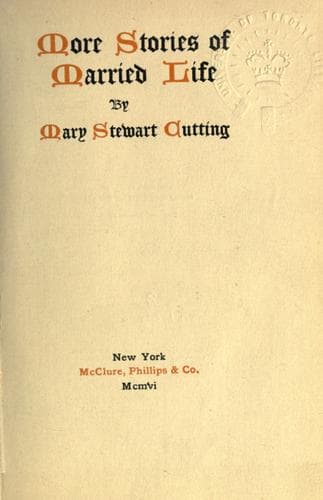
Married people -- United States -- Fiction; United States -- Social life and customs -- 20th century -- Fiction
“Yes, _Robert_!” she called back elfishly, and fled, passing her mother
with no recognition, and actually going out in young Fanshawe’s car with
him for all the afternoon, only coming back in time for dinner, which was
a state function, with guests, and going to bed immediately afterwards.
It is strange how one untoward event disrupts all the working order of
the mind; that which has given joy loses its flavour, that which has been
counted on as sure becomes fluctuant. Everything has to arrange itself
anew. If Elinor wrote a note to a Robert who had neglected to appear, it
was not from the dictates of reason, but from a novel and jealous desire
for his presence. If Annette and Joseph sat up unusually late after the
guests had departed it was, perhaps, because figuring over a housekeeping
text-book wasn’t as satisfying as sometimes, and they had to keep at it
a little longer to capture the pleasure of that future living together.
Even to the most unselfish, the most vernally patient of lovers waiting
may show a grim face, all “bare of bliss” at times, especially when
confronted with a boy of twenty-one who has money and to spare for that
leap over the matrimonial barriers. It was only after thoroughly studying
a mysterious way of Approaching a Butcher, by which, although special
cuts and roasts were so much a pound, you got a whole diagrammic ox for a
dollar, that that prophetic feeling of happiness mingled once more with
the lovers’ goodnight kiss. Heaven only knows what delicate sentiment was
embedded in those visionary steaks and chops!
Long after Joseph had gone Mrs. Malison and Annette talked in the
mother’s room, with low, painfully murmuring voices, taking counsel
together into the small hours. It was three of the clock when the
hurrying of soft footsteps and a touch at the chamber door startled them,
and then a piteous voice:
“Momsey; oh, momsey!”
The mother was up on the instant, opening the door; by the light in the
hall, Tina’s eyes, ice-blue, stared at her over the lace frills of her
night-dress. “I came to tell you—if you feel like that—the way you looked
to-day—I’ll tell Francis I won’t marry him; it will _kill_ me; but if you
are happy it doesn’t make any difference. I can’t _stand_ seeing you look
like that! It will kill me, but you’ll be happier, any way.”
“Oh, dear me!” said Mrs. Malison in despair—anxiety lent roughness to her
voice. “This is nonsense, Tina. Come up-stairs this minute. The idea!
with nothing on your feet—you’ll get your death of cold.” She led the
girl to her own bed, tucking the soft form with resolute fingers, and
lying down herself afterwards under the coverlet with her cheek against
Tina’s chill flesh.
“Oh, Tina, as if mother could ever be glad if you were unhappy! It’s just
because I fear that if you have what you want that it will only be for
your unhappiness that I look as I do. If your father were only at home!”
Public-domain text, read in full here on John Shaqi.
Reviews
Reviews
No reviews yet
Be the first to share your thoughts on this work.
Elsewhere in the archive
Join the Discussion
Join the discussion
Sign in to leave a comment or review.
Sign InorCreate an account