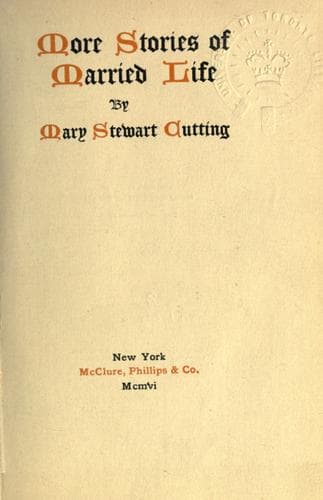
Married people -- United States -- Fiction; United States -- Social life and customs -- 20th century -- Fiction
“I will not get him a dictionary,” said Violet. Yet she weakened after
a tour through the shops. She could find nothing for her father-in-law
that appealed in the least to an imagination all ready to be fired. Yet
it was joy to be out for Christmas shopping in the crisp air to one who
had been so little able lately to go abroad, while before her raptured
vision she saw ever a wee sock hung by the nursery hearth, and a tiny
lighted tree. Many little children were to be made happy this holy-tide
because her child had come to her—Violet’s thank-offering had flowed
by many streams to reach unseen baby hands. As she went along now she
stopped to slip coins into the palms of longing boys and girls looking in
at Christmas-decked windows.
“Oh, _Violet_!”
It was Mrs. Tom who clutched her. “Isn’t it dreadful—the rush! I’m nearly
dragged to pieces. I’ve just bought an inkstand for father, in the shape
of a peach, with a thermometer on it—the kind of thing no one ever uses,
but I was desperate. I’ve a big woolly sheep for your baby, but if you
think he’s too little for it——”
“Oh, _no_!” cried Violet, her face rosy with pleasure. “How dear of
you!” She could have embraced Mrs. Tom before crossing over to the
toy store, a ravishing spot, one window of which was given up to
regiments and regiments of lead soldiers afoot and on horseback, on a
green plain dotted with little round white tents. The other window was
filled with dolls sitting at tea-tables, swinging, or lying in pink or
blue-and-white beds like the baby’s at home. When Violet was a little
girl she had always been taken through this shop at Christmas time;
it was one of the delights of the season, but never had it seemed so
delightful as now, when she was buying toys for a “first” Christmas,
while music-boxes played, and animals squeaked, and rattling, whirring
mechanical toys ran riot.
She stopped at last by a counter laden with glittering tree ornaments.
Opposite were shelves filled with stationary engines varied with an
occasional boat or locomotive. There seemed to be no clerk there, but
a small boy, seven or eight years of age, with a white sailor cap
pushed back to make a halo around his short golden curls, was walking
backward and forward, regarding the display with rapt, angelic eyes, and
incidentally putting out the tip of his chubby forefinger to touch a
cylinder or an electric battery. Looking up suddenly he caught Violet’s
eye; they both smiled, and she came over to him. So might her own little
boy look some day.
“Do you like engines?”
“Yes,” said the boy with a deep, indrawn breath. He forestalled
criticism: “I’m not too little to have one; my papa says so! He’ll
run it for me. He’s down-stairs now.” He pointed to the shelf. “Do
you see this one? That’s where you pour the alcohol in—and this is
the steam gauge—and here’s the safety-valve. She’s a hummer! And this
’lectric—that’s a hummer, too!”
“Oh,” said Violet. She sought for more definite accomplishment. “What do
they do?”
Public-domain text, read in full here on John Shaqi.
Reviews
Reviews
No reviews yet
Be the first to share your thoughts on this work.
Elsewhere in the archive
Join the Discussion
Join the discussion
Sign in to leave a comment or review.
Sign InorCreate an account