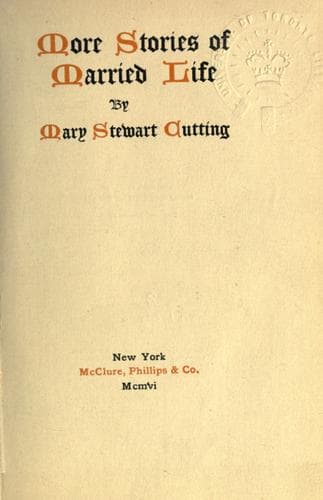
Married people -- United States -- Fiction; United States -- Social life and customs -- 20th century -- Fiction
She took her seat on a wooden settle outside the door of the office,
which, open at the top, was screened off with ground glass in one corner
of the long room, and waited her turn for an audience. She hardly saw the
inquiring glances given her from time to time by the clerks; she was full
of an intensity of purpose that cut through conventions like a knife. But
presently the conversation carried on by the rising voices of men within
the office forced itself upon her consciousness unpleasantly.
“Mein Gott! then I lose twenty t’ousand dollar! Consider what that means
to me, shentlemen. At this time, at _this_ time, it is ruin!”
“You should have looked out for that before, Hartmann,” answered a cold
voice, that the listener recognized as Nelson’s. “We gave you opportunity
to examine the goods—you cannot say we did not. If your man was a fool
it’s not our fault. We gave you opportunity.”
“Oh, oppo-_chu_nity,” moaned Hartmann. “Mein Gott, what oppo-_chu_-nity!
And the whole cargo rotten! Consider, shentlemen, that it is ruin.”
White’s high shrill tones broke in with an imprecation, “Consider—as
you’re so fond of the word—that you tried to cheat us, and got caught;
consider that you tried to cut _our_ throat, and we’ve cut _yours_. You
might have known you hadn’t a ghost of a chance with us. We _know_ you’re
ruined, and we don’t _care_. Understand that. We don’t care. Any one
who thinks he can work that game on us gets left. You’ve got the rotten
cargo, and we’ve got your twenty thousand dollars, and we’re going to
_keep_ it. If I were you I wouldn’t talk too much about the story, you
don’t show up any too well in it.”
“But my wife, my shildrens,” moaned the man.
“See here, Hartmann,” said Nelson, with dignity, “this is business.
Either you talk business, or get out of here. On second thoughts you get
out of here anyway. We’ve had enough of you for one day. You think so,
too, White? Shall I get somebody to put you out, Hartmann? No? Then _go_!”
He held the office door open, with a compelling gesture of his free hand
and a little man, bowed together, weeping and mumbling by turns, came
stumbling out as if blinded. As he did so, a boy with papers slipped into
the office, and behind him came a tall, pale clerk, with shabby clothes,
and a gentle, anxious face.
“Ah, Cramer,” said Nelson, half looking up from the papers as he scanned
them quickly in turn before affixing his signature. “What can I do for
you to-day?”
“I was told that you wanted to speak to me, sir,” said Cramer.
“Mr. White, I believe, takes your department in hand. White!”
“The fact is,” said White, “we shall not need you after the first of the
month, Mr. Cramer. You asked for an increase of salary.”
“I cannot live on what I get now,” said Cramer. “I have others to
support.”
Public-domain text, read in full here on John Shaqi.
Reviews
Reviews
No reviews yet
Be the first to share your thoughts on this work.
Elsewhere in the archive
Join the Discussion
Join the discussion
Sign in to leave a comment or review.
Sign InorCreate an account