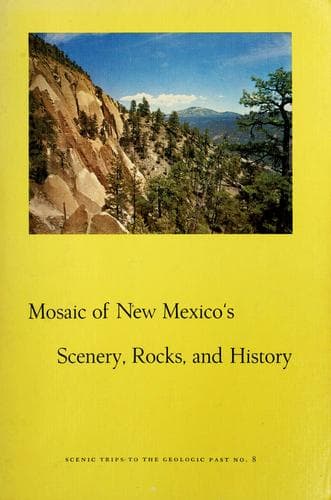
Mosaic of New Mexico's Scenery, Rocks, and History
History
Mosaic of New Mexico's Scenery, Rocks, and History
Geology -- New Mexico; New Mexico -- Description and travel; New Mexico -- History
Originally, the waters of the desert also could be described as fish
deserts. Only three recognized kinds of food fish, as we know them
today, inhabited the waters of this region. The trout was limited to the
cutthroat species or subspecies. These were found as one subspecies in
the Rio Grande drainage and the other subspecies in the Arkansas River
drainage. The latter is reduced in numbers but a few remnants remain in
the headwaters. The former is being artificially propagated and is being
maintained successfully. The trout found in the Gila River drainage,
originally thought to be a cutthroat, then a rainbow, has been recently
described as a separate species. These trout, like the Arkansas River
fish, remain as remnants in the headwaters. For the most part, the
native trout have had a difficult time surviving in recent years because
of the change in water and land use; the habitat has become exceedingly
restricted.
Channel catfish were originally found in the Rio Grande drainage and
continue to maintain themselves satisfactorily. Water and land
manipulation, however, present a serious threat, even to this hardy
fish.
There are records that the gulf eel once came up the Rio Grande during
part of its life cycle. This fish of the ocean has long since
disappeared—the fate of many migrating fish when confronted with
man-made obstructions in the watercourses.
Waterfowl were in great abundance once, in both the upper Rio Grande and
the Pecos River drainages. These birds utilized the vast marsh areas of
the valleys during spring and fall migrations. It is presumed that there
was very little nesting of waterfowl in the early years.
The mammals that live in or near the water, principally fur bearers,
were in abundance as long as water habitat was abundant and prior to
unrestricted trapping. With the exception of the beaver (since restocked
and protected), many of the fur bearers once numerous are now extremely
limited in numbers or approaching extinction. There is only an
occasional sighting of the otter which was once relatively plentiful.
Habitat for the various water mammals, birds, and fish is found in the
drainage systems. The major system is the Rio Grande that flows through
the center of the state; the Pecos River is its tributary. In this
system are six of the seven life zones and conditions of habitat
suitable to almost any form of water-dwelling life.
There is a noticeable habitat change due to several causes, such as
ranching, irrigation, urban development, and a general minor change in
climatic conditions. Many variations are in direct relation, such as
improper grazing, unscreened irrigation diversions, dams, and sewage
disposal, to mention a few. There is an indication of a long-term
warming of the general Southwest, and though this change is fractional,
it does have a basic effect on habitat.
Public-domain text, read in full here on John Shaqi.
Reviews
Reviews
No reviews yet
Be the first to share your thoughts on this work.
Elsewhere in the archive
Join the Discussion
Join the discussion
Sign in to leave a comment or review.
Sign InorCreate an account