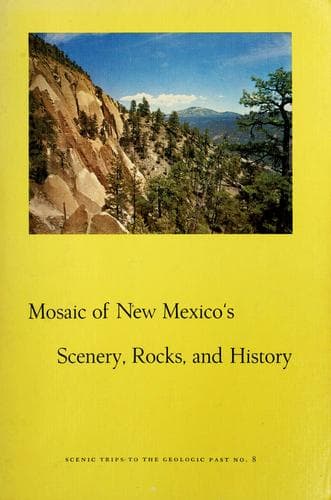
Mosaic of New Mexico's Scenery, Rocks, and History
History
Mosaic of New Mexico's Scenery, Rocks, and History
Geology -- New Mexico; New Mexico -- Description and travel; New Mexico -- History
The highest points in New Mexico are in the north-central region. Here,
along the backbone of the Sangre de Cristo Mountains, tower Wheeler Peak
(13,160 feet above sea level), northeast of Taos, and South Truchas Peak
(13,102 feet), northeast of Santa Fe. Snow lingers on these lofty spires
all year around except during an especially hot August. Highest
peaks—they must be capped by the youngest rocks. But no, the quartzites
and gneisses, hard rocks made up of quartz and feldspar, that hold up
these pinnacles against the attack of water and ice are among the oldest
rocks known in the Southwest—perhaps as much as two billion years old.
These Precambrian rocks lay deep beneath the earth’s surface from early
Paleozoic time (500 m.y. ago?) until early Neogene time, then were
uplifted along great breaks in the earth’s crust, uplifted slowly and
intermittently during the span of time from about 20 m.y. ago to perhaps
1 m.y. ago.
[Illustration: Figure 4. Gypsum dunes of White Sands]
How did these ancient rocks form? What did New Mexico look like during
the dawn of geologic history? The record in stone is fragmentary. But
about two billion or so years back, thick masses of quartz sandstone
were laid down in north-central New Mexico, as well as vast lenses of
mud, and some beds of feldspar-rich sandstone. Volcanic activity was
intense; huge flows of rhyolite and andesite were poured out over most
of the state, and these in turn, along with the muddy and sandy
sediments, were intruded by enormous masses of hot granite. Mile-high
mountains were formed, and during the stretch of this early geologic
time, called the Precambrian Era, the high peaks were eroded by rain,
wind, and sun until some were worn down to featureless plains sloping
toward the ancient ancestral oceans.
[Illustration: Figure 5. Staurolite twin crystals in mica schist]
Public-domain text, read in full here on John Shaqi.
Reviews
Reviews
No reviews yet
Be the first to share your thoughts on this work.
Join the Discussion
Join the discussion
Sign in to leave a comment or review.
Sign InorCreate an account