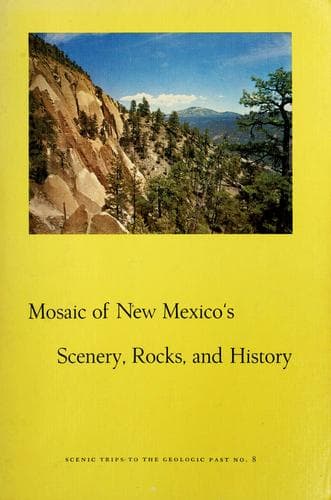
Mosaic of New Mexico's Scenery, Rocks, and History
History
Mosaic of New Mexico's Scenery, Rocks, and History
Geology -- New Mexico; New Mexico -- Description and travel; New Mexico -- History
Northern New Mexico was above sea level during late Mississippian time;
in some areas caves developed in the porous limestones, and in other
places the limestones were eroded to a residuum of chert and red clay.
The land must have looked like the karst areas of Indiana, Kentucky, and
Illinois today—with lost rivers flowing into sink holes, numerous caves,
and many underground rivers. Only the southernmost part of the state was
awash in the late Mississippian seas, and in these salt waters, rocks of
the Helms and Paradise formations settled. They are typical nearshore
beds of yellowish limy sandstone, green limy shales, and brown sandy
oolitic limestones. Plant fossils occur intermingled with marine animal
remains; the plant fragments were washed into the shallow seas from the
land areas of the central and northern parts of the state.
The Pennsylvanian Period (280 to 310 m.y. ago) was a time of change.
Previously, northern New Mexico had been an emergent lowland or barely
awash in shallow waters, while to the south shallow but extensive seas
held sway, the spawning ground of the vertebrates and invertebrates that
evolved between 310 and 600 m.y. B.C. But mountains were built during
the Pennsylvanian, and the whole pattern of land and sea was altered.
The sun rose on north-south aligned ranges interspersed with
north-south-trending seas (fig. 7). Somewhere north of Albuquerque a
mighty range of mountains, the Uncompahgre Range, arose to shed rock
debris into adjoining ocean basins. To the southeast, a lower but
prominent range, the Pedernal Mountains, stretched from the present-day
Pedernal Hills southward to somewhere near Ruidoso and Piñon. Rocks
eroded from this landmass were dumped westward into the Orogrande basin
which occupied the region near the present-day White Sands; there as
much as 3000 feet of beds accumulated—impure sandstones, dark shales,
fragmental limestones, and even some gypsum during the end phase of
Pennsylvanian sedimentation.
Rocks filled the Delaware basin in southeastern New Mexico—limestones,
sandstones, and black shales that now produce oil and gas. In
northwestern New Mexico west of Grants and mostly west of the Zuni
Mountains, a low land area, the Zuni Islands, was the source of eroded
residuum released into an ocean channelway that ran north-northwest
through central New Mexico from El Paso to Farmington. And in the
northeast, granite hills of the Sierra Grande Arch stood above the
shallow Pennsylvanian seas.
In the Four Corners region, broken rock from the Uncompahgre Range was
rushed westward into the Pennsylvanian-age Paradox Basin. Amid the
clastic limestones, black shale, gypsum, and salt of this basin are
oil-bearing lenses. Today, oil wells pump this black “gold” from the
ancient rocks—wells almost in the shadow of Shiprock’s famous spire.
Public-domain text, read in full here on John Shaqi.
Reviews
Reviews
No reviews yet
Be the first to share your thoughts on this work.
Join the Discussion
Join the discussion
Sign in to leave a comment or review.
Sign InorCreate an account