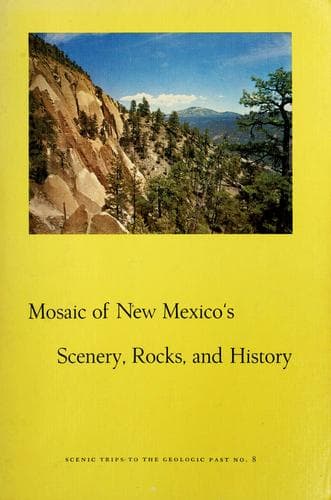
Mosaic of New Mexico's Scenery, Rocks, and History
History
Mosaic of New Mexico's Scenery, Rocks, and History
Geology -- New Mexico; New Mexico -- Description and travel; New Mexico -- History
The Pennsylvanian Period was a time of coal making on the greatest scale
in the earth’s history. Extensive swamps and marshes, the habitat of
peat and ultimately coal, were almost lacking in New Mexico. Thus, only
thin scattered lenses of coal occur in the Pennsylvanian beds of the
state. The lands of this period were covered by tree ferns, scale trees,
horsetail rushes, and primitive conifers. In the shallow seas, the
dominant invertebrates were fusulinids (fig. 8), small-shelled
protozoans shaped like grains of wheat. Abundant cockroaches, large
dragonflies, and spiders swarmed over the land.
[Illustration: Figure 7. New Mexico during Pennsylvanian time]
Permian Rocks
The Permian Period (230 to 280 m.y. ago) dawned with renewed rising of
the highlands in northern New Mexico and southern Colorado. Floods of
red sand and clay, washed from the rotting hills, wiped out the seas of
northern and central New Mexico, and intertongued southward with marine
limestones. These early Permian rocks are the Hueco Limestone near El
Paso, there 2200 feet thick, the Abo Redbeds near Albuquerque, and the
upper Sangre de Cristo Redbeds southeast of Santa Fe. Wherever the
redbeds crop out, their dark reddish brown hue, speckled and striped
with spots and streaks of green, enlivens the drab gray-and-brown
landscape. Some of the reddish coloring is from angular grains of red to
orange feldspar, but most is in thin brilliantly tinted skins of
hematite that coat the sand grains and saturate the clays. In northern
and central New Mexico, amphibians and other primitive vertebrate
animals lived amid the red soils and sands; their bones and imprints
have been preserved on thin flat slabs of sandstone that now decorate
sidewalks and patios.
Figure 8. Fossil specimens
[Illustration: Bryozoan
_Fenestrellina._]
[Illustration: Fusulinid
_Fusulina._]
[Illustration: Coral
_Lophophyllidium._]
The early Permian seashore, where limy muds beyond the surf intermingled
with red sandy muds swept from the north, vacillated somewhere north of
Alamogordo with each sea-level change. Amid the breakers, and as
submarine banks in the shallow waters, reefs grew—moundlike masses of
shell debris and calcite mud trapped among frondlike calcareous algae.
Near Tularosa, these algal “bioherms” are sixty feet high and extend
within broad belts half a mile wide. In southeastern New Mexico, these
buried “Abo” reefs have yielded much oil.
Public-domain text, read in full here on John Shaqi.
Reviews
Reviews
No reviews yet
Be the first to share your thoughts on this work.
Join the Discussion
Join the discussion
Sign in to leave a comment or review.
Sign InorCreate an account