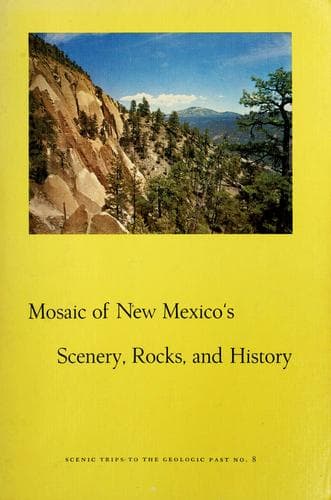
Mosaic of New Mexico's Scenery, Rocks, and History
History
Mosaic of New Mexico's Scenery, Rocks, and History
Geology -- New Mexico; New Mexico -- Description and travel; New Mexico -- History
The delicate balance between land and sea swung upward at the end of San
Andres time as these late Permian seas retreated to southern New Mexico.
The deep Delaware basin was the only persistent marine body of water. It
was rimmed by magnificent towering barrier reefs, the Goat Seep and
Capitan reefs that now are host to Carlsbad Caverns. These reefs were
similar to the present-day Great Barrier Reef of Australia, except that
the Capitan and Goat Seep reefs surrounded an inland sea whereas the
Australian reef borders a continent. The Capitan reef is about 400 miles
long, and other than oceanward channels cut through to the south,
completely encircled the 10,000-square-mile Delaware basin. At its
heyday, the Capitan reef was barely awash, and teeming with life, in
contrast to the silent, stagnant deeps of the Delaware basin which were
about 2000 feet below sea level only a few miles away from the barrier
reef. On the steep slope into the basin, huge slump blocks of
fossiliferous reef limestone slid, mingling with fossil-hash sand. These
“flank” beds dip steeply from the massive reef core to interfinger with
the black sandy limestones of the basin.
The Delaware basin was a marine feature throughout Late Paleozoic time;
its northwestern border is now marked by the southeast-trending front of
the Guadalupe Mountains southeast of Carlsbad; its north edge was
east-northeast of Carlsbad, and it extended southward into West Texas.
Shallow “shelf” seas reached irregularly and intermittently northward
and northwestward from the Capitan reef and mingled with low islands
throughout all but southeastern New Mexico. Landward, away from the
Delaware basin, the rocks change from massive, thick, light-gray
limestones of the reefs into thin units of thin-bedded dolomite, then
abruptly into alternating beds of gypsum and redbeds, the Artesia Group
of rocks, and finally, marking the distant shorelines, into thin units
of red mudstone and red sandstone, the Bernal Formation. Evaporation of
sea water was excessive, and average temperatures high; the climate
varied from semiarid in northwestern New Mexico to subtropical in the
Delaware basin area—a contrast and a similarity to today’s climate.
[Illustration: Figure 9. Castile gypsum sample]
Public-domain text, read in full here on John Shaqi.
Reviews
Reviews
No reviews yet
Be the first to share your thoughts on this work.
Join the Discussion
Join the discussion
Sign in to leave a comment or review.
Sign InorCreate an account