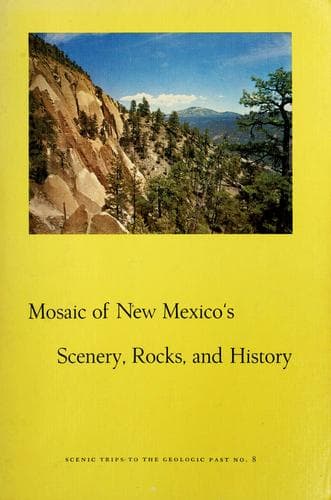
Mosaic of New Mexico's Scenery, Rocks, and History
History
Mosaic of New Mexico's Scenery, Rocks, and History
Geology -- New Mexico; New Mexico -- Description and travel; New Mexico -- History
Latest Permian time saw the dramatic end of the Paleozoic Era. Most of
New Mexico was uplifted above sea level, with only the Delaware basin
remaining as a land-locked sea, much like the Caspian Sea today, but
with channels open periodically southward to the ocean. The rocks of
this waning part of the Permian are called the _Ochoan Series_; they
show an abrupt and striking change from the underlying Carlsbad reef
limestones and associated black basin-filling limestones up into the
laminated gypsum-anhydrite of the basal Ochoan rocks, the Castile
formation. Normal marine conditions ended almost instantaneously. Excess
of evaporation lowered the water level of the inland sea; the
accumulated brine (concentrated salty sea water) killed the life on and
near the Capitan reef, and thick beds of anhydrite were precipitated.
The lowest beds of the Ochoan Series, the Castile Anhydrite, and the
overlying Salado Salt, mostly filled the deep depression that was the
Delaware basin; the upper beds, the Rustler Dolomite and Dewey Lake
Redbeds, lap over the edges of the basin and in places rest irregularly
upon the Capitan limestone.
These are unusual rocks. The Castile (about 1800 feet thick) is thinly
banded, with thicker bands (laminae, thin layers) of light-gray
gypsum-anhydrite alternating with thin laminae of dark-brown calcite
(fig. 9). This lamination is believed due to annual changes, the brown
calcite being precipitated during the summer and the gray anhydrite
during the winter. On the surface, the calcium sulfate mineral is
gypsum, but at depths of about 600 feet, these laminae are anhydrite.
Addition of water to anhydrite has changed it to gypsum wherever ground
water penetrated the laminae.
The Salado Salt, about 2000 feet thick, is almost entirely of rock salt
(halite), with important interbeds of potassium-rich minerals—red
sylvite, gray langbeinite, brownish bitter-tasting carnallite, and
pale-red polyhalite. As all these salts are highly soluble in water, the
Salado Salt nowhere “crops out” at the surface. East of Carlsbad,
however, the potash-rich beds are mined underground, and supply about
ninety per cent of the United States’ production—used chiefly as
fertilizer.
Public-domain text, read in full here on John Shaqi.
Reviews
Reviews
No reviews yet
Be the first to share your thoughts on this work.
Elsewhere in the archive
Join the Discussion
Join the discussion
Sign in to leave a comment or review.
Sign InorCreate an account