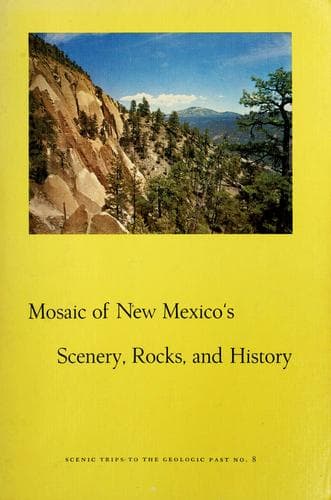
Mosaic of New Mexico's Scenery, Rocks, and History
History
Mosaic of New Mexico's Scenery, Rocks, and History
Geology -- New Mexico; New Mexico -- Description and travel; New Mexico -- History
Toward the end of the Cretaceous, the Laramide “revolution” began, and
New Mexico along with most of North America emerged from beneath the
seas, to be high and dry to the present. The revolution, an extensive
upheaval of the earth’s crust, saw uplift of the San Juan Mountains area
in southwestern Colorado and large volcanoes spouting fire and ashes
nearby. Fragments of the eroded mountains and debris from these
andesitic volcanoes were flushed southward by streams and steam to
settle as thick piles of mud, sandstone, and conglomerate, the McDermott
and Animas formations in the San Juan Basin. The last moment of
Cretaceous time, if we could be so precise, was ushered out almost
unnoticed—with mountains rising to the north and the andesitic-quartz
detritus being laid down to the south in the upper beds of the Animas
Formation.
Similarly, mountains arose during Late Cretaceous time in north-central
New Mexico and south-central Colorado, about on the site of the
present-day Sangre de Cristo range northeast of Taos, and shed erosional
gravels and muds into the Raton Basin area. Alluvial fan gravels and
sands grade eastward into dark muds and coals laid down in swamps and on
floodplains. These rocks now cap the rugged mesas seen northwest of the
Santa Fe Railway from Raton southward—the cliff-forming Trinidad
Sandstone and the dark siltstones, sandstones, black shales, and coal
beds of the Vermejo and Raton formations. The Kaiser Steel Corporation
mine near Koehler extracts coal from these beds. Again, the exact end of
the Cretaceous is marked only by some obscure boundary between beds, in
that area within the Raton Formation.
During the Cretaceous Period, the deciduous trees—such as the oak,
maple, poplar, and elm that dominate today’s flora—became common. The
covered-seed plants, the angiosperms, are the most notable of the
Cretaceous plants, but the development of the modern floras was an
antecedent to the great expansion of mammals and birds during the
following Cenozoic Era. Reptiles ruled the earth, led by the dinosaurs
(fig. 10) and their distinctive group, the horned large-skulled
ceratopsians such as Triceratops. The small, hairy, warm-blooded mammals
were still insignificant creatures that ran from their huge dinosaur
lords, but they ate reptile eggs, and so excelled the sluggish reptiles
in mental and physical activity that they adapted swiftly to the
changing environments of the Laramide revolution—and became dominant as
the pea-brained reptiles were unable to stand the changes.
Public-domain text, read in full here on John Shaqi.
Reviews
Reviews
No reviews yet
Be the first to share your thoughts on this work.
Elsewhere in the archive
Join the Discussion
Join the discussion
Sign in to leave a comment or review.
Sign InorCreate an account