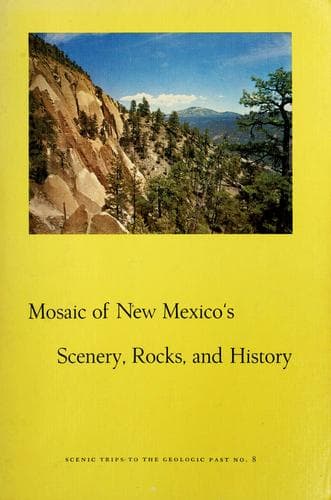
Mosaic of New Mexico's Scenery, Rocks, and History
History
Mosaic of New Mexico's Scenery, Rocks, and History
Geology -- New Mexico; New Mexico -- Description and travel; New Mexico -- History
The shallow seas of the Cretaceous swarmed with invertebrate life;
foraminifers (unicellular protozoans) in uncountable billions make up
large parts of the chalky limestones. Mollusks, particularly clams like
oysters and the heavy ribbed Inoceramus, and complexly sutured
cephalopods, the ammonites, as well as the internal-shelled belemnoids
(that look like cigars), were most numerous among larger marine animals.
Reef builders in southwestern New Mexico were the peculiarly corallike
clams, the rudistids. Widespread warm humid climates seem to have
prevailed throughout the state during most of the Cretaceous.
LANDSCAPES AND MINERAL RESOURCES
Thus as the Cretaceous seas withdrew from New Mexico, the Cenozoic Era
dawned, and never again have marine waters shaped the landscapes. The
rocks, Precambrian, Paleozoic, Mesozoic, and Cenozoic, and their ancient
movements determine New Mexico’s spectacular landscapes. They tell tales
of the endless war between erosion and hard rock, show the deposition of
sediments, their uplift, and their eventual destruction. The result is
striking scenery—volcanic mountains, as Mount Taylor, Sierra Blanca,
Valle Grande—fresh lava flows near Carrizozo and Grants—volcanic necks
like Shiprock and Cabezon—White Sands, the work of the wind—El Morro,
Enchanted Mesa, Acoma, and badlands near Santa Fe, the result of
weathering and erosion—great fault-line escarpments of the Sandia,
Manzano, San Andres, and Sacramento mountains—the work of underground
waters at Carlsbad Caverns. And man adds his erosive powers—the huge
open-pit copper mine at Santa Rita and countless excavations for rock to
build homes, to straighten highways.
[Illustration: Figure 10. Make way for ’is lordship, the Dinosaur!]
The sun can be harsh and hot, the rain sparse, the winter nights fierce
cold. But within the rocks are natural resources undreamed of by the
early Indians, almost untouched by the Spanish, and with potential
beyond vision for the future. Water, being scarce, is one of the more
important resources. With an average yearly precipitation of only
fifteen inches, and more than half of the state receiving less than that
average, water is a problem! Farming must depend upon irrigation, the
water being drawn from streams or “mined” from underground “pools” where
it had been accumulating for centuries.
Public-domain text, read in full here on John Shaqi.
Reviews
Reviews
No reviews yet
Be the first to share your thoughts on this work.
Elsewhere in the archive
Join the Discussion
Join the discussion
Sign in to leave a comment or review.
Sign InorCreate an account