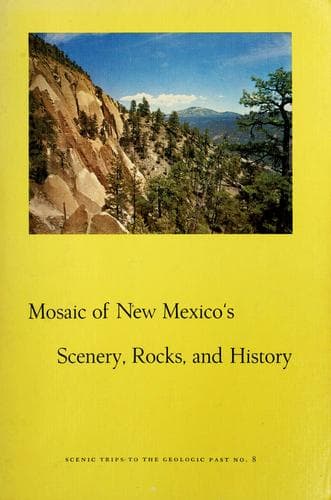
Mosaic of New Mexico's Scenery, Rocks, and History
History
Mosaic of New Mexico's Scenery, Rocks, and History
Geology -- New Mexico; New Mexico -- Description and travel; New Mexico -- History
Forests, game, and fish are lucrative resources somewhat unexpected in a
semiarid state; sheep and cattle—in this the stronghold of the cowboy,
famous in gunfighter lore—each total more than a million. New Mexico’s
1965 mineral production, valued at $781.9 million, ranked seventh among
the states. Principal commodities won from the rocks, in order of value,
were oil, potash, natural gas, uranium, copper, sand and gravel, zinc,
coal, crushed stone, and perlite. Sizeable quantities of barite, beryl,
carbon dioxide, cement, clays, gem stones, gold, gypsum, helium, iron
ore, lead, limestone, magnesium compounds, manganese, mica, molybdenum,
pumice, salt, silver, sulfur, and vanadium were also mined. The huge
open-pit copper mine at Santa Rita, the many uranium mines near Grants,
the underground potash mines near Carlsbad, and the thousands of oil and
gas wells in the northwestern and southeastern parts of the state are
typical of man-made landscape features attributable to mineral
exploitation in New Mexico. Numerous old mine dumps, rotting mine
shafts, and spooky ghost towns are reminders of past fortunes won and
lost.
The rocks, the work of water, wind, and sun, and the not insignificant
upheavals by man have shaped New Mexico’s landscapes. Blended with its
blue skies, warm sun, and the products of three cultures—Indian,
Spanish, and American—the rocks and their movements have made the
landscapes a land of enchantment.
Earth wears a mantle rich with lore,
of storied fabric finely spun,
That tells of kingdoms come and gone,
of legions lost and battles won.
No seer no monarch can divine,
the cryptic writings; he alone,
Who humbly speaks the tongue of earth,
can find a story in a stone.
Before Coronado
_by_ Robert H. Weber
The cultural heritage of New Mexico is a rich and colorful one, blending
as it does the three separate traditions of Indian, Spanish, and
Anglo-American. Of these, the lifeways of the Indian, ancient and
modern, are of particular interest to both the visitor and resident.
These were the first inhabitants of the New World, whose roots extend
back in time many thousands of years before the first European set foot
here. People who had adapted themselves to the varied and often harsh
environments of desert, plain, valley, canyon, and mountain; who
witnessed the disappearance of the large mammals of the Pleistocene Ice
Age and concomitant changes in climate and vegetation; the first
prospectors and miners seeking flint, obsidian, turquoise, clay, salt,
and mineral pigments; early traders exchanging valued minerals and
handicrafts for shells of the coastal regions; hunters and farmers,
architects and builders, civic and religious leaders, philosophers and
critics, skilled craftsmen and artists, explorers and soldiers—all
ancient counterparts of those who were to follow.
Public-domain text, read in full here on John Shaqi.
Reviews
Reviews
No reviews yet
Be the first to share your thoughts on this work.
Elsewhere in the archive
Join the Discussion
Join the discussion
Sign in to leave a comment or review.
Sign InorCreate an account