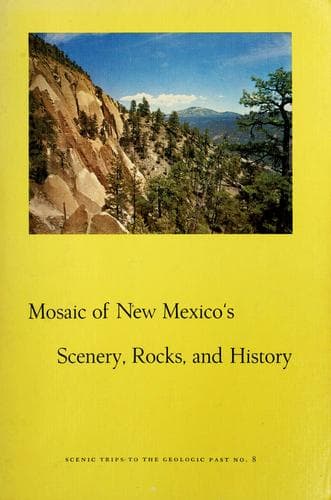
Mosaic of New Mexico's Scenery, Rocks, and History
History
Mosaic of New Mexico's Scenery, Rocks, and History
Geology -- New Mexico; New Mexico -- Description and travel; New Mexico -- History
Gila Cliff Dwellings National Monument, forty-seven miles north of
Silver City and at the edge of the Gila Wilderness Area, contains a
series of ruins that portray the development of the agricultural Indians
who lived south of the Mogollon Mountains. Specifically, the ruins
represent a branch of the generalized culture known as Mogollon.
Although part of the road to the Monument was paved in 1963, the last
four-mile stretch is still primitive and should not be attempted in an
ordinary passenger car except during the summer and in dry weather. In
spite of the difficult road, more than 23,000 people visited the
Monument during 1965. The last four miles of the road have been recently
paved.
The earliest ruin yet found within the Monument is a Mogollon pit house
of a type that was made about 500 A.D. It is roundish and, on the east
side, has a narrow ramplike entrance some two feet wide and ten feet
long. The people of this period did only a little farming (corn and
beans), a little hunting, and gathered much uncultivated plant food.
They made a fairly good plain-brown pottery and undoubtedly were skilled
in a number of crafts whose products have since disappeared. Such things
as nets and snares, baskets, and wooden tools last but a short time in
open sites.
Other, later, pit house types may be seen in the Monument. Pit houses
were prevalent in the area until about 1000 A.D., when influences from
the Anasazi (Pueblo) Indians of the northern part of the Southwest began
to affect the Mogollon people.
Square houses, built above the ground, became the style; some were of
masonry, some of adobe construction, and some were built of wattle
(wooden rods and twigs). A new type of pottery was also introduced at
about the same time: white with black designs.
The principal ruins in the Monument are the cliff dwellings, which were
built during the twelfth and thirteenth centuries. They, too, reflect
the northern pueblo influence. About forty rooms, remarkably well
preserved, are fitted into a series of chambers, or caves, in a low
cliff of Gila Conglomerate. By about the beginning of the fifteenth
century, the area was abandoned by the farming Indians.
Gran Quivira National Monument
Significant chapters in the absorbing history of New Mexico were written
at three sites that have been made units of the National Park System.
Gran Quivira National Monument, near the center of the state southeast
of Mountainair, preserves the ruins of a frontier Spanish mission that
had been built, used, and abandoned by 1675. The Monument contains
twenty-one ruined house mounds of Indian pueblos and ruins of two
mission churches. It was the presence of the Indians at this location,
of course, that attracted the Franciscan missionaries.
[Illustration: A look at ruins of Gran Quivira]
Public-domain text, read in full here on John Shaqi.
Reviews
Reviews
No reviews yet
Be the first to share your thoughts on this work.
Elsewhere in the archive
Join the Discussion
Join the discussion
Sign in to leave a comment or review.
Sign InorCreate an account