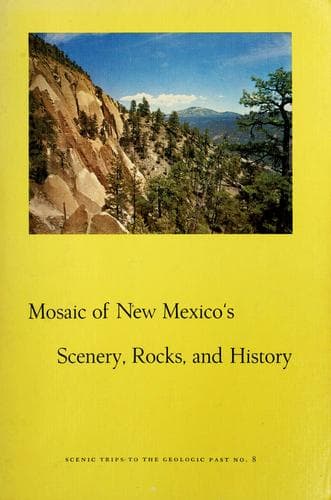
Mosaic of New Mexico's Scenery, Rocks, and History
History
Mosaic of New Mexico's Scenery, Rocks, and History
Geology -- New Mexico; New Mexico -- Description and travel; New Mexico -- History
Carson National Forest is a trout fisherman’s delight. For the hunter,
Rocky Mountain mule deer, elk, and antelope are found in all parts of
the Forest. Small game is plentiful, and rabbits provide many hours of
hunting pleasure. Beaver, muskrat, mink, weasel, marten, and skunk are
the principal fur bearers, and turkey, grouse, ducks, geese, quail, and
doves make up the game bird population. Predators include the mountain
lion, bobcat, coyote, and fox.
More than 40 developed camp and picnic grounds, most of which are
accessible year round, welcome the visitor. Among them, Echo
Amphitheater picnic ground on U.S. Highway 84, south of Canjilon, is a
striking natural echo chamber formed by centuries of wind and water
erosion in the rugged sandstone rock. “If you stand near the chamber,
you only have to whisper, and your words come back in a spooky echo.”
About five miles south on U.S. Highway 84 is the Ghost Ranch Museum,
with live native Southwestern animals and conservation exhibits,
including a living and growing display showing on-the-ground Forest
Service Multiple Use Management of the mythical Beaver National Forest,
the “smallest National Forest in the world.”
Ranger stations at Canjilon, El Rito, Gobernador, Penasco, Questa, Taos,
and Tres Piedras provide local information and recreation maps.
[Illustration: Echo Amphitheater surrounds part of the trail to
campground]
Santa Fe National Forest
The Santa Fe National Forest, with headquarters in Santa Fe, lies
directly south of the Carson National Forest on both sides of the Rio
Grande and is the center of a region rich in natural resources as well
as historic and geologic interests. The two divisions of the Forest
contain the high mountains to the east and west in the central section
of the state. The Pecos Division to the east of the Rio Grande is the
location of the major part of the Pecos Wilderness Area, one of the
earliest of such areas to be established.
The Pecos Division is so named because the Pecos River, which later
joins the Rio Grande in Texas, heads among its towering mountains in a
beautiful alpine basin sometimes called the _Pecos Horseshoe_. The Pecos
River is one of the state’s largest streams and supplies some of its
most important irrigation projects. This division of the Forest includes
the southern part of the Sangre de Cristo range and was first known as
the Pecos River Forest Reserve, established in 1892—the oldest National
Forest in the Southwest. The division abounds in clear, cold mountain
lakes and streams. Truchas Lakes, Pecos Baldy, Stewart Lake, Spirit
Lake, and Lost Lake, as well as many mountain streams, lure not only the
fisherman but the hiker and camper to their wilderness beauty.
Public-domain text, read in full here on John Shaqi.
Reviews
Reviews
No reviews yet
Be the first to share your thoughts on this work.
Elsewhere in the archive
Join the Discussion
Join the discussion
Sign in to leave a comment or review.
Sign InorCreate an account