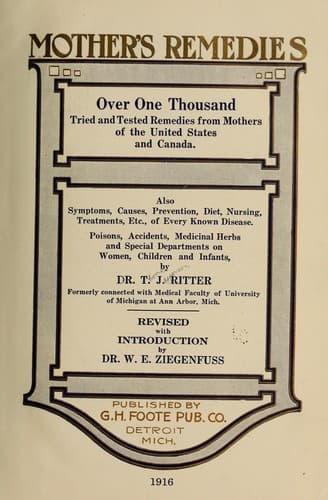
Mother's Remedies: Over One Thousand Tried and Tested Remedies from Mothers of the United States and CanadaRitter, Thomas Jefferson
Science
Mother's Remedies: Over One Thousand Tried and Tested Remedies from Mothers of the United States and Canada
Ritter, Thomas Jefferson
Etiquette; Formulas, recipes, etc.; Medicine, Popular
Symptoms.--It usually affects first the mucous membrane of one cheek, near
the corner of the mouth, as a dark, ragged, sloughing ulcer and spreads
for two or three days before the substance of the cheek is infected. If
you grasp the cheek between the thumb and finger you can then feel a hard
and sensitive lump. The cheek may be eaten through by the third day,
though a week generally passes before this happens. There is a burning
watery discharge from the unhealthy wound. The breath smells terribly and
it is almost unbearable. The gangrene may spread over one half of the face
of the side affected.
TREATMENT.--The death rate is eighty to ninety per cent. This is a very
dangerous disease and a doctor must be in attendance. Cut, away all the
dead tissue by using burning caustics, such as fuming nitric acid, solid
zinc chloride, nitrate of silver, carbolic acid on the actual canker.
Sometimes mild applications like sub nitrate of bismuth, chloride of
potash or the following do well:--
Sulphate of copper 2 drams
Powdered cinchona 1/2 ounce
Water enough to make 4 ounces
Mix and apply. Peroxide of hydrogen is good as a disinfectant or boric
acid solution, etc., may be used. Keep up the patient's strength.
Fortunately this disease is rare. I have never seen a case in practice.
Salivation.--Stop the mercury, keep the bowels open and use the same
antiseptic washes as directed for sore mouth.
[100 MOTHERS' REMEDIES]
Chlorate of Potash Solution, Soda Solutions, Boracic Acid
Solutions.--Brush the ulcers with nitrate of silver sticks. Keep the mouth
clean with hot water washes and some of the antiseptics put in the water
as boric acid, soda, glycothymotine, listerine, etc.
ACUTE DYSPEPSIA.--(Acute Indigestion, Acute Gastritis). "Gaster" is the
Greek for stomach; "itis" means inflammation,--thus acute inflammation of
the stomach. It may be acute or chronic. When acute it may be called acute
gastritis, acute gastric catarrh, acute dyspepsia or acute indigestion.
When chronic it may be called chronic gastritis, chronic catarrh of the
stomach, chronic dyspepsia or chronic indigestion.
Causes.--This is a very common complaint and is usually caused by eating
foods that are hard to digest, which either themselves irritate the
stomach, or remain undigested, decompose, and so excite an acute
dyspepsia, or indigestion, or it may be caused by eating or taking in more
than the stomach can digest. A frequent cause is eating decomposing food,
particularly in hot weather. Alcohol is another great cause.
Symptoms.--In mild cases. Distress in the stomach, headache, weary
feeling, thirst, nausea, belching of wind, sour food, and vomiting; the
tongue is heavily coated and the saliva increased. In children there are
loose bowels and colicky pains. It lasts rarely more than twenty-four
hours. Vomiting usually relieves the patient.
Public-domain text, read in full here on John Shaqi.
Reviews
Reviews
No reviews yet
Be the first to share your thoughts on this work.
Elsewhere in the archive
Join the Discussion
Join the discussion
Sign in to leave a comment or review.
Sign InorCreate an account