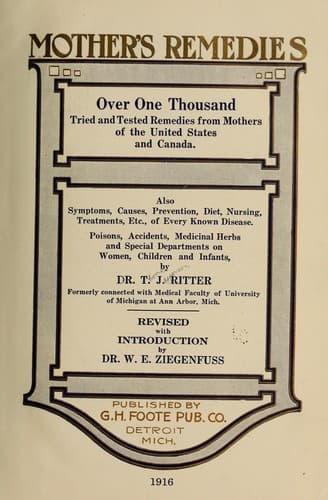
Mother's Remedies: Over One Thousand Tried and Tested Remedies from Mothers of the United States and CanadaRitter, Thomas Jefferson
Science
Mother's Remedies: Over One Thousand Tried and Tested Remedies from Mothers of the United States and Canada
Ritter, Thomas Jefferson
Etiquette; Formulas, recipes, etc.; Medicine, Popular
The most common forms of rupture protrude through one of the natural
openings or weak spots in the abdominal walls, as for instance, the
inguinal (groin) and femoral canals. The femoral canal is located at the
upper and inner part of the thigh, and this place is a seat of rupture,
especially in women. Rupture may also occur at the navel, when it is
called umbilical hernia or rupture. The contents of a hernia are bowel and
omentum (a covering of the bowel) separately or together. The bowel
involved in a rupture is usually the lower portion of the small bowel, but
the large bowel is sometimes affected. A sac covers the bowel or omentum
in a rupture. This sac consists of the protruded portion of peritoneum,
which has been gradually pushed through one of the canals (inguinal or
femoral) or of the process of peritoneum, which has been carried down by
the testicle in its descent, and the connection of which with the
peritoneum of the abdomen still continues, not having been obliterated, as
it usually is before birth. The former is called an acquired rupture sac;
the latter is a congenital rupture sac, and it is found only in groin
(inguinal rupture).
Causes.--Rupture is more common in men than in women. It may occur at any
time of life. The majority of cases occur before middle age, and the
largest number during the first ten years of life, owing to the want of
closure of the peritoneum which is carried down by the testicles before
birth. Rupture is most frequently strangulated between the ages of forty
and fifty.
Location.--The great majority of cases of rupture are groin or inguinal
rupture.
Symptoms.--A fullness or a swelling is first noticed in the groin, which
is made worse in standing, coughing and lifting. This disappears on lying
down and reappears on rising in many cases, even at first; coughing makes
the lump or swelling harder. It may come on both sides, when it is called
double rupture or hernia.
MOTHERS' REMEDIES.--Rupture, Poultice for.--"Take equal parts of lobelia
and stramonium leaves; make a poultice and apply to the parts. Renew as
often as necessary. This combination makes a very effective poultice and
is sure to give relief."
PHYSICIANS' TREATMENT.--A person should wear a truss (support) that fits
perfectly, and this should not cause any pain or discomfort. The truss
should be worn all day, taken off at night after going to bed and put on
before rising, when still lying down. If it is put on after rising a
little of the gut may be in the canal and pressed down by the support.
There are many kinds of supports.
Public-domain text, read in full here on John Shaqi.
Reviews
Reviews
No reviews yet
Be the first to share your thoughts on this work.
Elsewhere in the archive
Join the Discussion
Join the discussion
Sign in to leave a comment or review.
Sign InorCreate an account