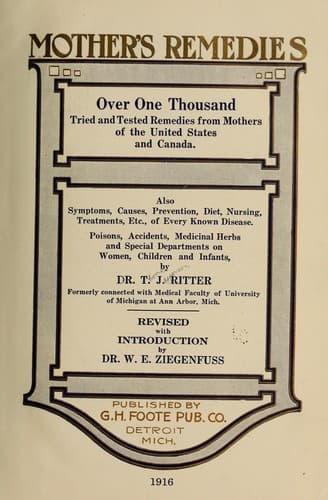
Mother's Remedies: Over One Thousand Tried and Tested Remedies from Mothers of the United States and CanadaRitter, Thomas Jefferson
Science
Mother's Remedies: Over One Thousand Tried and Tested Remedies from Mothers of the United States and Canada
Ritter, Thomas Jefferson
Etiquette; Formulas, recipes, etc.; Medicine, Popular
Cutaneous (skin) piles are operated upon as follows.--Each one is grasped
in turn with a pair of strong forceps and snipped off with the scissors,
or removed with a knife. Close the wound with sutures, if necessary, and
dress it with gauze. Small ones need no sutures. Be careful not to remove
too much tissue. Much after-pain can be prevented by placing in the rectum
a suppository containing one-half grain of opium or cocaine before either
of the above operations are performed. The after treatment is quite
simple. Keep the patient quiet, cleanse the parts frequently, and secure a
soft daily stool. Cleanse with tepid boiled water with clean sterilized
gauze and give salts in small doses, one to two drams to produce a stool.
INTERNAL PILES. Symptoms.--The two prominent symptoms are bleeding and
pain. The bleeding is usually dark. It may be slight and appear as streaks
upon the feces or toilet paper; it may be moderate and ooze from the anus
for some time after a stool, or it may be so profuse as to cause the
patient to faint from loss of blood while the "bowels are moving." Death
may follow in such a case unless the bleeding is stopped. The blood may
look fresh and fluid or if retained for some time, it looks like coffee
grounds, sometimes mixed with mucus and pus. Patients who bleed profusely
become pale and bloodless, and are very nervous and gloomy and they
believe they are suffering from cancer or some other incurable trouble.
The first the patient notices he has internal piles is when a small lump
appears at the end of the bowel during a stool and returns spontaneously;
afterwards the lump again protrudes after the stool and others may appear.
They become larger and larger, come down oftener and no longer return
spontaneously, but must be replaced after each stool. As a result of this
handling, they grow sensitive, swollen, inflamed and ulcerated, and the
sphincter muscle becomes irritable. Later on one or more of the piles are
caught in the grasp of the sphincter muscle and rapidly increases in size.
It is then hard to relieve them, and when returned they act as foreign
bodies, excite irritation and they are almost constantly expelled and the
same procedure goes on at each stool. The sphincter muscle contracts so
tightly around them as to cause strangulation and unless properly treated
they become gangrenous and slough off.
[150 MOTHERS' REMEDIES]
Recovery, Pain, etc.--The pain is not great in the early stages, but when
the muscle grasps and contracts the pile or piles it becomes terrible and
constant. Piles rarely end fatally. Palliative treatment does not afford a
permanent cure. They frequently return, but by care and diet many can be
kept from returning so frequently. They should be treated upon their first
appearance when the chances of a permanent cure without an operation are
much better.
Public-domain text, read in full here on John Shaqi.
Reviews
Reviews
No reviews yet
Be the first to share your thoughts on this work.
Elsewhere in the archive
Join the Discussion
Join the discussion
Sign in to leave a comment or review.
Sign InorCreate an account