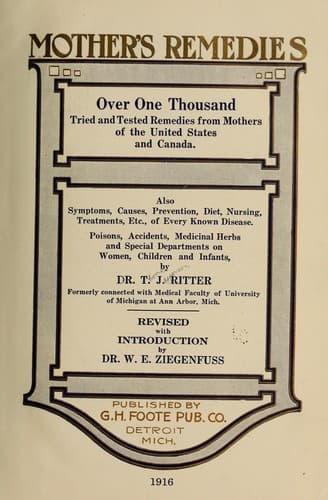
Mother's Remedies: Over One Thousand Tried and Tested Remedies from Mothers of the United States and CanadaRitter, Thomas Jefferson
Science
Mother's Remedies: Over One Thousand Tried and Tested Remedies from Mothers of the United States and Canada
Ritter, Thomas Jefferson
Etiquette; Formulas, recipes, etc.; Medicine, Popular
Treatment.--The cause should always be removed if possible. Rest in bed,
and as a diet use only milk; if the congestion is bad, use dry cupping
over the kidneys and inject large quantities of hot normal salt solution
in the bowels. Hot fomentations of wormwood or smartweed are of benefit.
If you can get the patient into a sweat the congestion will be somewhat
relieved by it.
[156 MOTHERS' REMEDIES]
CHRONIC CONGESTION OF THE KIDNEYS. Causes.--Diseases of other organs and
obstruction to the return of the circulation in the veins. Cirrhosis of
the liver causes it. The kidney is enlarged dark red, the urine is
diminished, with albumin and casts and sometimes blood.
Treatment.--Remove the cause if possible. Fluid diet, like milk, broths,
etc. Dry cupping or sweating materials can be used. Rest in bed if
possible. The bowels should be kept open, and the kidneys should rest.
BLOOD IN THE URINE. (Haematuria). Causes.--The congestion of the kidneys,
pernicious malaria, etc., nephritis, tuberculosis, kidney stones. The
urine looks smoky and dark, or bright red.
Treatment.--This depends upon the cause. The patient must rest in bed and
the kidneys should not be stimulated. Cold applications to the loins. Hot
applications would injure.
URAEMIC TOXAEMIA.--This means poison in the blood occurring in acute and
chronic nephritis (inflammation of the kidneys). The cause is unknown. The
disease is acute and chronic.
ACUTE URAEMIA. Symptoms.--The onset may be sudden or gradual. The headache
is severe, usually on the back top of head (occipital) and extending to
the neck; there is persistent vomiting with nausea and diarrhea attending
it. This may be due to inflammation of the colon. Difficulty in breathing,
which may be constant or comes in spells. This is worse at night, when it
may resemble asthma; fever if persistent, is usually slight until just
before death. General convulsions may occur. There may be some twitching
of the muscles of the face and of other muscles. The convulsions may occur
frequently. The patient becomes abnormally sleepy, before the attack, and
remains so. One-sided paralysis may occur. Sudden temporary blindness
occurs sometimes. There may be noisy delirium or suicidal mania. Coma
(deep sleep) may develop either with or without convulsions or delirium,
and is usually soon followed by them; sometimes by chronic uraemia or
recovery.
Public-domain text, read in full here on John Shaqi.
Reviews
Reviews
No reviews yet
Be the first to share your thoughts on this work.
Elsewhere in the archive
Join the Discussion
Join the discussion
Sign in to leave a comment or review.
Sign InorCreate an account