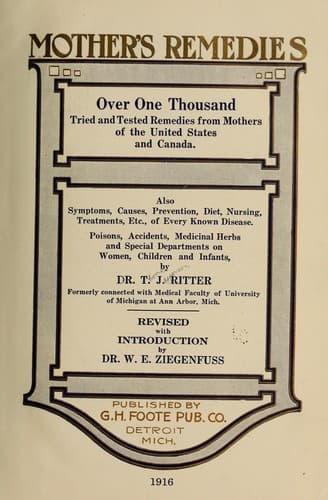
Mother's Remedies: Over One Thousand Tried and Tested Remedies from Mothers of the United States and CanadaRitter, Thomas Jefferson
Science
Mother's Remedies: Over One Thousand Tried and Tested Remedies from Mothers of the United States and Canada
Ritter, Thomas Jefferson
Etiquette; Formulas, recipes, etc.; Medicine, Popular
KIDNEY STONE. (Renal Calculus. Nephro-Leithiasis).--Forming of a stone or
gravel in the kidney or its pelvis may occur in intra uterine, (before the
child is born), in the womb, or at any age. A family tendency, sedentary
life, excesses in eating and drinking and very acid urine predispose. They
vary in size from that of fine sand to that of a bean.
Symptoms.--Patients may pass gravel for years without having an attack of
renal (kidney) colic, and a stone may never lodge in the ureter. A person
may pass an enormous number of calculi. Dr. Osler speaks of having had a
patient who had passed several hundred kidney stones (calculi) with
repeated attacks of kidney colic. His collection filled an ounce bottle. A
patient may pass a single stone and may never be troubled again. A stone
remaining in the kidney may cause dull aching pain in the affected kidney,
or the pain may be referred to the other side and sometimes there may be
blood or pus in the urine, with chill and fever due to pyelitis. Kidney
(renal) colic comes on when a stone enters the ureter, if it is at all
large. At attack may set in abruptly, without any apparent reason, or it
may follow a strain in lifting. The pain may be agonizing in character,
which starts in the flank of the affected side, passes down along the
course of the ureter and is felt in the testicle and along the inner side
of the thighs. The testicle is drawn back. The pain may also go through
the abdomen and chest, and be very severe in the back. In severe attacks
nausea and vomiting are present and the patient is collapsed; sweating
breaks out in his face and the pulse is feeble and weak. The pain lasts
from an hour to several days, until the stone reaches the bladder, partial
suppression of the urine during the attack occurs, but a large quantity of
urine is usually passed after it and a feeling of soreness may, be present
for several days. The stone may again cause pain in passing through the
urethra, or it may remain in the bladder as a nucleus for a bladder
calculus (stone). Dr. Osler gives Montaigne's description as follows;
"Thou art seen to sweat with pain, to look pale and red, to tremble, to
vomit well nigh to blood, to suffer strange contortions and convulsions,
by starts to let tears drop from thine eyes, to urine thick, black and
frightful water, or to have it suppressed by some sharp and craggy stone
that cruelly pricks and tears thee."
[162 MOTHERS' REMEDIES]
Public-domain text, read in full here on John Shaqi.
Reviews
Reviews
No reviews yet
Be the first to share your thoughts on this work.
Elsewhere in the archive
Join the Discussion
Join the discussion
Sign in to leave a comment or review.
Sign InorCreate an account