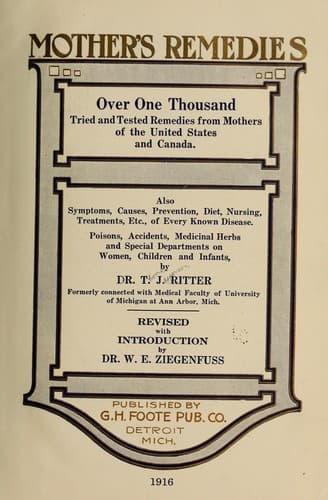
Mother's Remedies: Over One Thousand Tried and Tested Remedies from Mothers of the United States and CanadaRitter, Thomas Jefferson
Science
Mother's Remedies: Over One Thousand Tried and Tested Remedies from Mothers of the United States and Canada
Ritter, Thomas Jefferson
Etiquette; Formulas, recipes, etc.; Medicine, Popular
How Often?--As a rule, it attacks a person only once; yet there are
recorded cases of well observed second and third attacks, but fortunately
these are very rare. I once attended a family where they had it and
claimed to have had it before, but very lightly.
Incubation.--The vast majority of cases develop within three to five days
after exposure. If eleven days elapse without the appearance of symptoms
we may reasonably expect that the danger is past, at least in the great
majority of cases exposed.
Contagiousness.--There is danger of catching the disease during the stages
of incubation, eruption and scaling. It is most contagious in the last two
stages.
Onset.--Sometimes the onset is sudden; there may be a convulsion, preceded
by a sharp rise in the temperature. An examination in such cases may
reveal a marked sore throat or a membranous deposit on the tonsils
preceding the eruption, and nothing more. A chill followed by fever and
vomiting ushers in a large number of cases. These may be mild or severe.
The severity of these symptoms usually indicates the gravity of the
attack.
Rash.--The rash or eruption appears from twelve to thirty-six hours after
the onset, usually on the second day, and looks like a very severe heat
rash, but is finer and thicker. It consists of a very finely pointed
rose-colored rash. In mild cases it is hardly noticeable. Usually it first
appears on the upper part of the chest around the collar bones, spreads
over the chest and around upon the back. Also it is now seen on the neck,
beneath the jaw, behind the ears and on the temples, thence spreads over
the body. There is a paleness about the mouth and wings of the nose, while
the cheeks are flushed with a flame-like redness. There is much itching if
the rash is severe. It attains the full development at the end of two or
three days, and then gradually declines. In some cases the rash is seen
only twenty-four hours.
Fever.--The fever rises rapidly in the first few hours to 104 or 105-8/10
degrees. It remains high except in the morning, until the eruption reaches
its full development and falls with the fading eruption, and in
uncomplicated and typical cases, within six days becomes normal.
[INFECTIOUS DISEASES 169]
Sore Throat.--This we find on the pillars of the fauces, uvula, tonsils,
and pharynx, reddened and inflamed. Sometimes it is very severe, and a
membrane comes on one or both tonsils and pillars of the fauces. There is,
generally a severe sore throat, and this makes swallowing difficult.
Tongue.--The tongue is covered with a coating at the onset, and may
present a slightly reddened appearance at the borders and tip. The
papillae are prominent and covered and look like a strawberry sometimes,
or like the tongue of a cat. In fatal poisonous cases it becomes dry and
cracked.
Public-domain text, read in full here on John Shaqi.
Reviews
Reviews
No reviews yet
Be the first to share your thoughts on this work.
Elsewhere in the archive
Join the Discussion
Join the discussion
Sign in to leave a comment or review.
Sign InorCreate an account