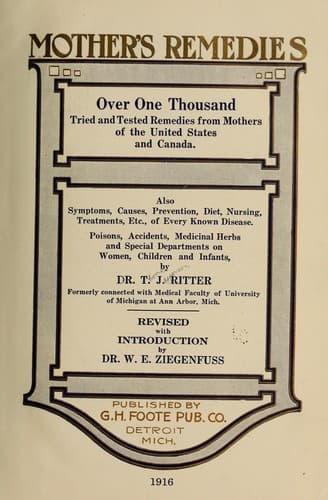
Mother's Remedies: Over One Thousand Tried and Tested Remedies from Mothers of the United States and CanadaRitter, Thomas Jefferson
Science
Mother's Remedies: Over One Thousand Tried and Tested Remedies from Mothers of the United States and Canada
Ritter, Thomas Jefferson
Etiquette; Formulas, recipes, etc.; Medicine, Popular
Treatment.--The patient should be kept in the house and isolated in bed as
long as the symptoms last. When there is much pain, laudanum diluted
one-third with water may be applied continually with a soft warm cloth.
Oil of hyoscyamus applied twice daily to the sore parts is good if
laudanum is not used. When the swelling goes down I know of nothing as
good as a hot bean poultice, which must be changed often so as to keep
hot. Bean poultice.--Simply boil the beans in water until they are soft
and thick enough to use as a poultice. The bowels should be kept open with
salts. The food must be liquid, such as milk, soups and gruels. If there
is not much fever, soft boiled eggs and milk toast from the beginning. Do
not use vinegar, acids or astringents.
[INFECTIOUS DISEASES 181]
WHOOPING-COUGH (Pertussis).--Whooping cough is an acute specific
infectious, disease caused by a micro-organism. It is characterized in a
majority of cases by a spasmodic cough, accompanied by a so-called whoop.
It is not only infectious, but very contagious. It is propagated through
the atmosphere in schools and public places; the air of which is
contaminated with the specific agent of the disease. This agent is thought
to reside in the sputum and the secretions of the nose and air passages of
the patient. It is very contagious at the height of the attack. The sputum
of the first or catarrhal stage is thought to be highly contagious. The
sputum in the stage of decline is also thought to be capable of carrying
the disease. It prevails in all countries and climates. During the winter
and spring months it is most frequent. At times it prevails as an
epidemic. It occurs most frequently in infancy and childhood, but a person
can take it at any age. Second attacks are rare. It is most frequent
between the first and second year; next most frequent between the sixth
and twelfth month. After the fifth year the frequency diminishes up to the
tenth year, after which the disease is very infrequent. Not everyone who
is exposed contracts the disease. It seems that whooping-cough, measles,
and influenza frequently follow one another in epidemic form. This is one
of the diseases much dreaded by parents. It is very tedious and endangers
the life of weak and young children by exhaustion. It is a terrible thing
to watch one with this disease, day in and day out. It can be known by the
impetuous, continuous and frequent coughing spells, following each other
rapidly until the patient is out of breath, with a tendency to end in
vomiting. When it comes in the fall or winter months there will likely be
spasmodic coughing until summer through the usual colds contracted. Summer
is the best time to have it.
Symptoms.--There is an incubation stage, but it is hard to determine its
length. After the appearance of the symptoms there are three stages; the
catarrhal, the spasmodic, and the stage of decline.
Public-domain text, read in full here on John Shaqi.
Reviews
Reviews
No reviews yet
Be the first to share your thoughts on this work.
Elsewhere in the archive
Join the Discussion
Join the discussion
Sign in to leave a comment or review.
Sign InorCreate an account