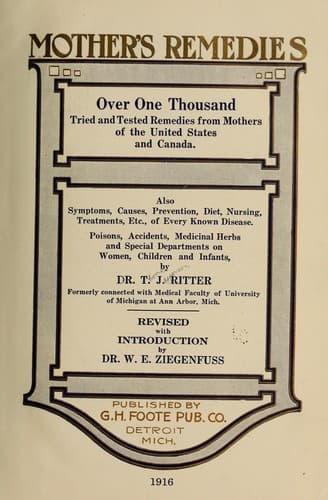
Mother's Remedies: Over One Thousand Tried and Tested Remedies from Mothers of the United States and CanadaRitter, Thomas Jefferson
Science
Mother's Remedies: Over One Thousand Tried and Tested Remedies from Mothers of the United States and Canada
Ritter, Thomas Jefferson
Etiquette; Formulas, recipes, etc.; Medicine, Popular
PHYSICIANS' TREATMENT for Diphtheria. Prevention.--The patient should be
isolated as soon as the spots or membrane are seen. Other children who
have been with the sick one should at once be given "immunizing" doses of
antitoxin, and the furniture of the sick room such as hangings, carpets.
rugs, etc., should be removed and disinfected, only the necessary articles
being kept in the room. The room should be kept well ventilated, but no
draught should get to the patient. The one nursing the patient should not
come near the other members of the family. All articles of clothing worn
by the patient should be dipped in a 1 to 2000 solution of corrosive
sublimate before they are removed from the sick room. (Other solutions may
be used; see Nursing Department). Dishes, etc., should be treated in the
same way and foods left over should be put in a vessel containing an
antiseptic solution, and then burned. Everyone going into the sick room
should cover their head with a cap and wear a robe-covering over their
clothes, and on leaving the room should gargle or rinse their mouth with a
solution of boric acid, about one or two teaspoonfuls to a glass of water,
The infant should not be nursed at the breast lest the breast become
infected; the milk should be pumped out and fed to the infant with a
bottle. If the infant has diarrhea milk must be stopped, the bowels
irrigated, and no milk given until all danger from this source is past.
The nurse must be careful of the discharges from the nose, mouth and
bowels. Discharges from the bowels and the urine must be received in a
vessel with an antiseptic solution in it like copperas, lime, etc. Cloths
used to receive the discharge from the nose and mouth should be thrown in
a vessel containing a solution of 1 to 2000 of corrosive sublimate and
then burned. The nurse should wear a gauze protection over her nose and
mouth when she is near the patient, and glasses, so that no sputum or
discharge from the patient can enter these organs. When the nurse leaves
the sick room for a rest or walk, she should change her clothes in an
unused room and put them where they can air, wash her hands, face and hair
in an antiseptic solution. Great care must be taken by the nurse, or she
will carry the disease. The doctor also must take the same care.
PHYSICIANS' MEDICAL TREATMENT.--Antitoxin is the best. 1/100 grain of
corrosive sublimate or more according to age is frequently given in the
severe cases and is beneficial.
Public-domain text, read in full here on John Shaqi.
Reviews
Reviews
No reviews yet
Be the first to share your thoughts on this work.
Elsewhere in the archive
Join the Discussion
Join the discussion
Sign in to leave a comment or review.
Sign InorCreate an account