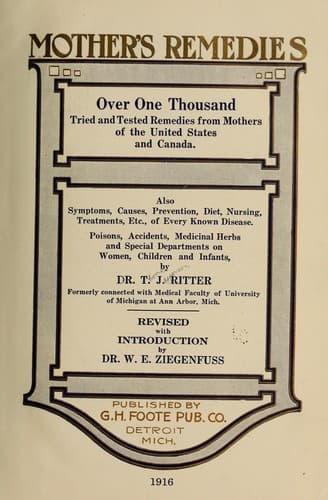
Mother's Remedies: Over One Thousand Tried and Tested Remedies from Mothers of the United States and CanadaRitter, Thomas Jefferson
Science
Mother's Remedies: Over One Thousand Tried and Tested Remedies from Mothers of the United States and Canada
Ritter, Thomas Jefferson
Etiquette; Formulas, recipes, etc.; Medicine, Popular
ACUTE TONSILITIS. (Follicular Inflammation of the Tonsils). Causes.--
Authors regard this as an infectious disease. It is met with more
frequently in the young; infants may take it. Some authors state it can be
communicated either through the secretions or by direct contact, as in the
act of kissing (Koplik). It is frequent in children from the second to the
fourth year, but it is more common after than before the fourth year. Sex
has no influence. In this country it is more common in the spring. The
predisposing causes are exposure to wet and cold and bad hygienic
surroundings. One attack renders a person more susceptible. It spreads
through a family in such a way that it must be regarded as contagious. The
small openings (Lacunae) of the tonsils become filled with products which
form cheesy-looking masses, projecting from the openings of the (Crypts)
hidden sacs. These frequently join together, the intervening tissue is
usually swollen, deep red in color and sometimes a membrane forms on it in
which case it may look like diphtheria.
[188 MOTHERS' REMEDIES]
Symptoms.--Chilly feelings or even a chill and aching pains in the back
and limbs may precede the onset. The fever rises rapidly and in the young
child may reach 105 degrees in the evening of the first day. The infant is
restless, peevish and wakeful at night; it breathes rapidly, and there is
high fever and great weakness. Nursing is difficult, not only on account
of the pain in swallowing, but because in the majority of cases there is
more or less inflammation of the nose. The bowels are disturbed as a
result of swallowing infectious secretions from the mouth with the food.
The tonsils are enlarged and studded with whitish or yellowish white
points. The glands at the angle of the jaws may be enlarged. In older
children the tonsils are enlarged and the crypts plugged with a creamy
deposit. The surface is covered with a deposit and the pillars of the
fauces, uvula and pharynx may all be inflamed. The tongue is coated, the
breath is bad, the urine high colored, swallowing is painful; the pain
frequently runs to the ear and the voice sounds nasal, as if one had mush
in his mouth when talking. In severe cases the symptoms all increase, and
the parts become very much swollen. Then the inflammation gradually
subsides, and in a week, as a rule, the fever is gone and the local
conditions have greatly improved. The tonsils, though, remain somewhat
swollen. The weakness and general symptoms are often greater than one
would suppose. The trouble may also extend to the middle ear through the
eustachian tubes.
Public-domain text, read in full here on John Shaqi.
Reviews
Reviews
No reviews yet
Be the first to share your thoughts on this work.
Elsewhere in the archive
Join the Discussion
Join the discussion
Sign in to leave a comment or review.
Sign InorCreate an account