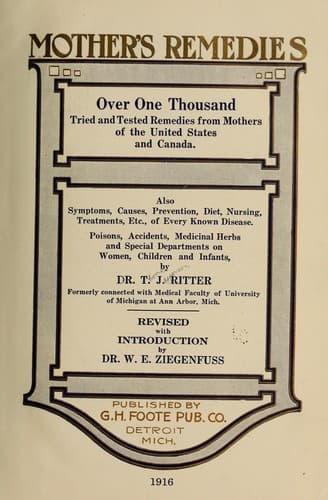
Mother's Remedies: Over One Thousand Tried and Tested Remedies from Mothers of the United States and CanadaRitter, Thomas Jefferson
Science
Mother's Remedies: Over One Thousand Tried and Tested Remedies from Mothers of the United States and Canada
Ritter, Thomas Jefferson
Etiquette; Formulas, recipes, etc.; Medicine, Popular
Sore Throat.--Spraying the throat with a solution of boric acid, one dram
to one pint of hot water, is good. Listerine is good in the same way and
dose.
Bowels.--They should be kept open from the first. Salts are usually handy
and good.
Medicines.--Ten grains Dover's powder at night is good; unless there is
much weakness. Some give quinine, some salol. Quinine, one to two grains,
is given one to three hours. Salol, five grains, every three hours,
especially for the backache.
Aspirin in five-grain doses for an adult every four hours is given very
much now. The bowels should be kept open with salts.
Diet.--Children should take milk if there is no vomiting or diarrhea. If
there is vomiting and diarrhea, give only water or diluted milk, or
nothing if they continue. Water can generally be given.
For adults a good, nourishing diet when convalescence commences is
necessary. During the sickness, milk, eggs,--raw and soft boiled, broths,
soups, milk toast, can be given. A person must be very careful after an
attack of the grip. He should remain in the house for some time, a week
after he is well and thinks he can go out.
TYPHOID FEVER.--Typhoid fever is an acute infectious disease caused by a
(Bacillus) germ, named after the discoverer (Eberth). This germ enters
into the system, as stated below, locates itself in different organs,
especially in the small intestine. It does its worst work in Peyer's
glands, situated in the small intestines. They enlarge, ulcerate, break
down and their structure is cast off into the bowel. This eating goes so
far, in some cases, that it eats through the tissue to the blood vessels
and other bleeding follows. Sometimes it goes through all the coats, the
peritoneal being the last one. If this occurs we have what is called
perforation of the bowel and the peritoneum around this perforation
inflames and there is the dread complication of peritonitis. This is very
fatal, as the patient is weakened from the inroads of weeks of fever and
from the effects of the poison germ. Typhoid fever is also characterized
by its slow (insidious), slyly, creeping onset, peculiar temperature,
bloating of the abdomen, diarrhea, swelling of the spleen, rose-colored
spots and a liability to complications, such as bleeding from the bowels,
peritonitis, bronchitis and pneumonia. Its average duration is three to
four weeks, often longer. In order to take this disease there must first
be the poison germ and then this enters into the system, generally through
water that contains the germ, milk, oysters and other foods, etc.
Cause.--The typhoid bacillus (typhoid). This enters into the alimentary
canal usually through contaminated water or with milk directly infected by
the milk or by water used in washing cans. Also through food to which the
germs are carried from the excreta (discharges) by flies, occasionally
through oysters by freshening.
Public-domain text, read in full here on John Shaqi.
Reviews
Reviews
No reviews yet
Be the first to share your thoughts on this work.
Elsewhere in the archive
Join the Discussion
Join the discussion
Sign in to leave a comment or review.
Sign InorCreate an account