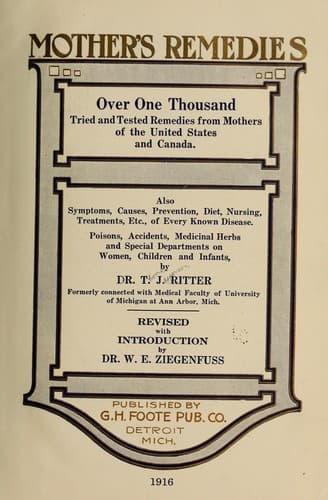
Mother's Remedies: Over One Thousand Tried and Tested Remedies from Mothers of the United States and CanadaRitter, Thomas Jefferson
Science
Mother's Remedies: Over One Thousand Tried and Tested Remedies from Mothers of the United States and Canada
Ritter, Thomas Jefferson
Etiquette; Formulas, recipes, etc.; Medicine, Popular
If used they must be moist and hot. Some doctors are opposed to them. An
antiphlogistine poultice is good. Apply it hot. For children you can
grease the whole side of the chest, back and front, with camphor and lard
and put over that an absorbent cotton jacket. In the early life of the
country, home treatment was necessary. Men and women were posted on herbs,
etc. Teas made of them were freely and successfully used. A great mistake
made was the indiscriminate use of lobelia in too large doses. We have
learned that the hot herb drinks in proper doses are of help. Teas made of
boneset, hoarhound, pennyroyal, ginger, catnip, hops, slippery elm, etc.,
were good and are now. They produced the desired result--sweating--and
relieved the congestion of the internal organs and re-established the
external or (peripheral) circulation. So in the home treatment of
pneumonia, etc., if you are so situated that you cannot get a physician
use teas internally for sweating, fomentations upon the painful part and
if done properly and not too excessively, they will accomplish the desired
result. With the corn sweat, I have saved many lives.
ERYSIPELAS.--Erysipelas is an infectious disease, and it is usually caused
by a germ which we call "streptococcus pyogenes." The disease shows itself
by its local symptoms, pain, swelling, etc., and also by general or
constitutional symptoms such as fever, headache, etc., as hereafter given.
Causes.--It is a disease that occurs at any time, and is sometimes
epidemic, that is, attacks many persons at a time, like La Grippe. It
occurs more often in the spring; it is contagious, and can be carried by a
third person or in bedding, etc.
Symptoms.--The type that appears upon the face is the most common. The
incubation lasts from three to seven days and it usually comes suddenly
with a chill, followed by an active fever and with the local inflammation.
In some cases the local condition appears first. There is at first
redness, usually of the bridge of the nose and it rapidly spreads to the
cheeks, eyes, ears, etc. It is red, shiny hot, drawing, but with a
distinct margin at its edges, showing how much skin is inflamed. It may
take the form of vesicles. The eyelids may be so swollen as to close, the
face and scalp greatly swollen with watery swelling of the eyelids, lips,
eyes, ears, etc. The glands under the jaw may become enlarged. The general
or constitutional symptoms may be severe. The fever may rise to 104 to 106
and terminates suddenly. The parts that were first affected become pale
and more normal, as other parts are involved. It occurs also on other
parts of the body. A sting of an insect sometimes looks like it at first;
but it does not spread like erysipelas. It seems to me to be more
dangerous around the head.
[INFECTIOUS DISEASES 221]
Public-domain text, read in full here on John Shaqi.
Reviews
Reviews
No reviews yet
Be the first to share your thoughts on this work.
Elsewhere in the archive
Join the Discussion
Join the discussion
Sign in to leave a comment or review.
Sign InorCreate an account