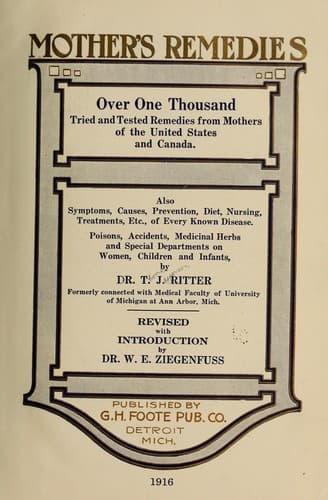
Mother's Remedies: Over One Thousand Tried and Tested Remedies from Mothers of the United States and CanadaRitter, Thomas Jefferson
Science
Mother's Remedies: Over One Thousand Tried and Tested Remedies from Mothers of the United States and Canada
Ritter, Thomas Jefferson
Etiquette; Formulas, recipes, etc.; Medicine, Popular
Causes.--It occurs most frequently in low lands, along sea coasts, and
swamps, particularly in the tropics and warmer portion of the temperate
zone. The exciting cause it what is called the plasmodous malarial, a
parasite developing in the body of all species of anopheles, a common form
of mosquito and transmitted to man, its intermediate host, by the bite of
the infected mosquitoes.
INTERMITTENT MALARIAL FEVER. (a) Tertian. (b) Quartan. (c) Quotidian.
Symptoms.--The symptoms of all these are the same, except that in tertian
fever, the paroxysms occur every third day; in quartan they occur every
fourth day. Quotidian occurs daily.
The incubation time is unknown. It consists usually of three stages, cold,
hot, and sweating, and they usually occur in the morning. "The cold stage
is ushered in by yawning, lassitude and headache, and rapid rise of
temperature; sometimes nausea and vomiting followed by shivering and
rather violent shaking with chattering of the teeth." It may last from ten
minutes to two hours. The internal temperature may rise to 104 to 106
degrees, while the surface is blue and cold, with severe headache, often
nausea and vomiting. Hot stage: this may last from one-half to five hours;
the temperature may increase somewhat, the face is flushed, the skin is
red and hot, great thirst, throbbing headache and full bounding pulse.
Sweating stage lasts two to four hours, and entire body may be covered;
fever and other symptoms abate and sleep usually follows. The patient
feels nearly well between attacks.
REMITTENT OR CONTINUOUS MALARIAL FEVER (Aestivo-Autumnal Fever).--This
form occurs in the temperate zone regions, especially in the summer and
autumn. The symptoms vary greatly. The fever may be irregularly
intermittent, but at longer intervals than the Tertian variety. The cold
stage is often absent, and in the hot the temperature falls gradually. The
appearance is often like typhoid for there may be then hardly any
remission of fever.
[INFECTIOUS DISEASES 229]
PERNICIOUS MALARIAL FEVER.--This is a very dangerous disease. The chief
forms are the comatose, algid and hemorrhagic.
(a) Comatose form is characterized by delirium or sudden coma (deep sleep)
with light temperature.
(b) The algid or asthenic form begins with vomiting and great prostration.
The temperature is normal or below normal. There may be diarrhea and
suppression of the urine.
(c) The hemorrhagic form includes malarial hemoglobinuria, hemoglobin in
the urine. Haemoglobin is the coloring matter of the red corpuscles.
Public-domain text, read in full here on John Shaqi.
Reviews
Reviews
No reviews yet
Be the first to share your thoughts on this work.
Elsewhere in the archive
Join the Discussion
Join the discussion
Sign in to leave a comment or review.
Sign InorCreate an account