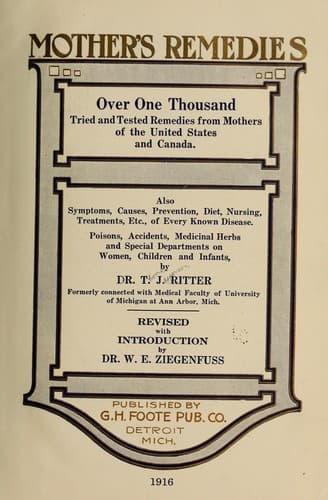
Mother's Remedies: Over One Thousand Tried and Tested Remedies from Mothers of the United States and CanadaRitter, Thomas Jefferson
Science
Mother's Remedies: Over One Thousand Tried and Tested Remedies from Mothers of the United States and Canada
Ritter, Thomas Jefferson
Etiquette; Formulas, recipes, etc.; Medicine, Popular
GLANDERS.--This is an acute disease of the horse and occasionally of man.
It is called "glanders" when the affection appears in the nostrils, and is
called "farcy" when in the skin.
Causes.--The bacilli is usually introduced from infected horses through
the nose, mouth and cheek, mucous membranes or skin abrasions (rubbing off
of the skin). There are large or small lumps in the skin, mucous membrane
of the nose and mouth.
Symptoms. Acute Glanders.--1. Incubation lasts from three to four days.
There are signs of inflammation at the site of infection and general
symptoms. In two or three days, small lumps appear on the mucous membrane
of the nose, and ulcerate, with a discharge of mucus and pus. Sometimes
these nodules die locally, and their discharge is then foul. The glands
around the neck are enlarged. An eruption appears over the face and
joints. Inflammation of the lungs may occur. Death may take place in eight
to ten days.
2. Chronic Glanders.--This may last for months. It acts like chronic cold
with ulcer in the nose. Some recover.
3. Acute Farcy.--The local and general signs are those of an infection,
with necrosis (local death) at the site (in the skin) of inoculation;
nodules, (lumps) known as "farcy buds" form along the lymphatics (glands)
and form pus. There may be pus collections in the joints and muscles.
Death often occurs in one to five days.
Chronic Farcy.--Tumors in the skin of the extremities, containing pus. The
process is local, the inflammatory symptoms light, and the duration may be
months or years.
[234 MOTHERS' REMEDIES]
Treatment of Glanders.--This disease does not often occur in man; it is an
awful affliction. All infected horses must be killed, it is dangerous for
man to be around one. If seen early, the wound should be cut out or burned
out with caustics, and afterwards dressed like any wound. The "farcy buds"
should be opened early. There is very little hope in acute cases of
glanders. In chronic cases recovery is possible, but it will be after a
long tedious time. There must be proper nourishing food and tonic
medicines. Each case should be treated according to the indications. It is
safe to say the parts should be thoroughly cut or scraped out and then
treated with antiseptics and the general system built up, by tonics and
stimulating remedies, if needed. As stated before, acute glanders and
acute farcy are almost always fatal.
BIG-JAW OR LUMP-JAW. (Actinomycosis).--This is an infectious disease of
cattle, less frequently of man, and it is caused by what is called the
"ray fungus." This grows in the tissues and develops a mass with a
secondary chronic inflammation.
This disease is widespread among cattle, and also occurs in the pig. In
the ox it is called the "big jaw." The infection may be taken in with the
food, and it locates itself often in the mouth or surroundings. Oats,
barley, and rye may carry the germ to the animals. The fungus may be found
even in decayed teeth.
Public-domain text, read in full here on John Shaqi.
Reviews
Reviews
No reviews yet
Be the first to share your thoughts on this work.
Elsewhere in the archive
Join the Discussion
Join the discussion
Sign in to leave a comment or review.
Sign InorCreate an account