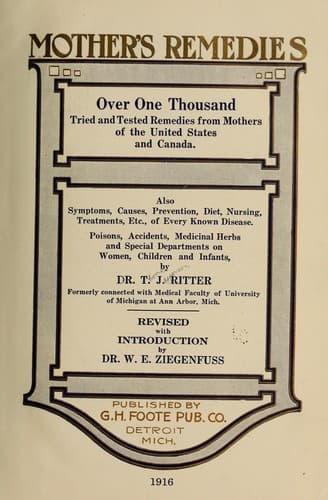
Mother's Remedies: Over One Thousand Tried and Tested Remedies from Mothers of the United States and CanadaRitter, Thomas Jefferson
Science
Mother's Remedies: Over One Thousand Tried and Tested Remedies from Mothers of the United States and Canada
Ritter, Thomas Jefferson
Etiquette; Formulas, recipes, etc.; Medicine, Popular
History.--Leprosy is supposed to have originated in the Orient, and to be
as old as the records of history. It appears to have prevailed in Egypt
even so far back as three or four thousand years before Christ. The Hebrew
writers make many references to it, and it is no doubt described in
Leviticus. The affection was also known both in India and China many
centuries before the Christian era. The old Greek and Roman physicians
were familiar with its manifestations, ancient Peruvian pottery represent
on their pieces deformities suggestive of this disease. The disease
prevailed extensively in Europe throughout the middle ages and the number
of leper asylums has been estimated at, at least, 20,000. Its prevalence
is now restricted in the lands where it still occurs while once it was
prominent in the list of scourges of the old world.
It is now found in Norway and to a less extent in Sweden, in Bulgaria,
Greece, Russia, Austro-Hungary and Italy, with much reduced percentage in
middle Europe; it is the rarest of diseases in England where once it
existed. In India, Java, and China, in Egypt, Algiers, and Southern
Africa, in Australia and in both North and South America, including
particularly Central America, Cuba, and the Antilles, it exists to a less
extent. It has been recognized in the United States chiefly in New
Orleans, San Francisco, (predominantly among the Chinese population of
that city). The disease has steadily decreased among the latter colonists
in Minnesota, Wisconsin and Iowa. Isolated cases have been recognized in
almost every state, and leprous cases are presented at the public
charities of New York, Philadelphia, Boston, etc. The estimated number of
lepers a few years ago in the United States varied between two hundred and
five hundred. It is represented as diminishing in frequency in the
Hawaiian Islands, Porto Rico and the Philippines. In the Hawaiian Islands
it spread rapidly after 1860, and strenuous attempts have been made to
stamp it out by segregating all lepers on the island of Molokai. There
were 1,152 lepers in that settlement in 1894. In British India, according
to the leprosy commission, there were 100,000 lepers in 1900.
Cause.--The bacillus, discovered by Hansen, of Bergen, in 1874, is
universally recognized as the cause of leprosy. It has many points of
resemblance to the tubercle bacillus. These bacilli have been found in the
dwellings and clothing of lepers as well as in the dust of apartments
occupied by the victims.
[238 MOTHERS' REMEDIES]
Public-domain text, read in full here on John Shaqi.
Reviews
Reviews
No reviews yet
Be the first to share your thoughts on this work.
Elsewhere in the archive
Join the Discussion
Join the discussion
Sign in to leave a comment or review.
Sign InorCreate an account