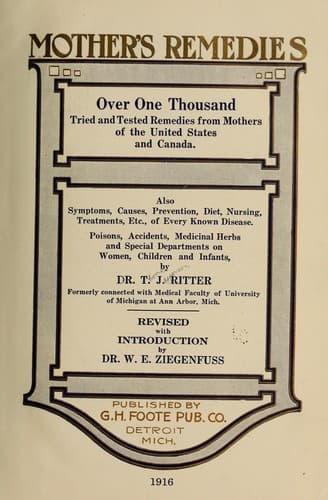
Mother's Remedies: Over One Thousand Tried and Tested Remedies from Mothers of the United States and CanadaRitter, Thomas Jefferson
Science
Mother's Remedies: Over One Thousand Tried and Tested Remedies from Mothers of the United States and Canada
Ritter, Thomas Jefferson
Etiquette; Formulas, recipes, etc.; Medicine, Popular
The incubation, or the time it takes for the disease to develop, varies,
but usually is from three to six months. There is a recorded case where
the person began to show symptoms of the disease thirteen days after
having received a severe wound on the head. The incubation period is
seldom longer than six months. The symptoms of the disease in the human
being vary within narrow limits. There are three classic symptoms usually
encountered, and these are fear, apprehension or excitement, together with
deglutitory (swallowing) spasms, terminating in general paralysis. The
patient remains conscious of his agony to the end, but the period of
illness is of short duration, lasting from one to three days.
The bites of rabid dogs cause ninety per cent of the cases in man and
animals. The cat is the next important factor in spreading the disease and
about six per cent of the cases are caused by this animal. For other cases
four per cent come from bites of horses, wolves, foxes, etc. The wolf in
Russia, or other animals like it, may be the chief cause there; but dogs
cause ninety per cent, taking all the cases found. Man, dog, cat, horse,
cattle, sheep, goat, hog, deer, etc., are subject to the disease either
naturally or experimentally. The disease is confined commonly to dogs,
because the dog naturally attacks animals of his own species and thus
keeps the disease limited mainly to his own kind. Naturally the dog
follows this rule, but on the other hand, in the latter stages of the
disease he usually goes to the other extreme and even attacks his own
master, etc. The dogs that are the most dangerous and do the greatest
damage are of the vicious breeds.
The rabbit or guinea pig is used for demonstration in the laboratory.
Guinea pigs respond to the virus more rapidly than do other animals and
therefore they are especially useful in diagnostic work. Rabbits, however,
on account of the convenient size and ease with which they are operated
upon, are usually the choice in the production of material used in
treating patients.
Public-domain text, read in full here on John Shaqi.
Reviews
Reviews
No reviews yet
Be the first to share your thoughts on this work.
Elsewhere in the archive
Join the Discussion
Join the discussion
Sign in to leave a comment or review.
Sign InorCreate an account