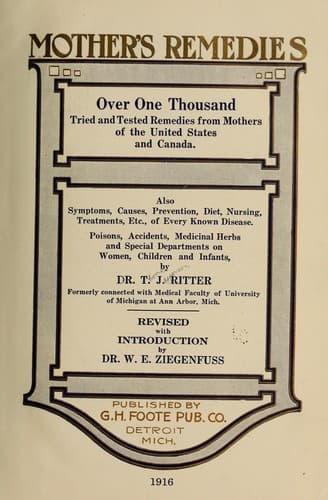
Mother's Remedies: Over One Thousand Tried and Tested Remedies from Mothers of the United States and CanadaRitter, Thomas Jefferson
Science
Mother's Remedies: Over One Thousand Tried and Tested Remedies from Mothers of the United States and Canada
Ritter, Thomas Jefferson
Etiquette; Formulas, recipes, etc.; Medicine, Popular
Belgium and Austria average one thousand dogs annually. There was a yearly
average in Germany of four hundred dogs, dying of rabies, until the law
requiring the muzzling of dogs was strictly enforced and since that time
the disease is practically unknown. We do not have strict quarantine laws
against dogs, and the result is death from hydrophobia in many states
annually. It was formerly believed that rabies was a hot weather disease.
The number of cases during the winter months of late years has disproved
that belief, for the records of the institute for treatment of hydrophobia
at Ann Arbor have shown a decrease of cases during the summer months. This
was before 1908. This shows that rabies is not a hot weather disease.
[244 MOTHERS' REMEDIES ]
Ordinarily cases of rabies occur here and there (sporadic), but if the
conditions are favorable epidemics break out. One dog may bite several
dogs and these dogs bite others and thus spread the disease to many. Not
every animal bitten by a mad dog develops the disease. The disease does
not always follow the bite. Only about forty per cent of all animals
bitten by a mad dog contract the disease. This is given by a noted
authority. Statistics also show that in man the disease develops in only
about twenty per cent of the cases in those who have been bitten by rabid
dogs. But in dealing with those who have been bitten such measures should
be taken as would be if they were certain of developing the disease; one
cannot tell how much poison enters the system in such cases and preventive
procedures should be taken. There are reasons why everyone who is bitten
does not contract the disease.
The location and character of the bite must be considered. Bites on the
head, neck and hands have been recognized as more dangerous, from early
times, and such bites produce fatal results quicker than do bites on other
parts of the body, and the reason is largely due to the fact that the
other parts of the body are more or less protected by the clothing, and
this clothing prevents the entrance of so much poison into the system.
Bites on the head give a high mortality rate and are rapidly fatal. The
close proximity to the brain is one reason.
Public-domain text, read in full here on John Shaqi.
Reviews
Reviews
No reviews yet
Be the first to share your thoughts on this work.
Elsewhere in the archive
Join the Discussion
Join the discussion
Sign in to leave a comment or review.
Sign InorCreate an account