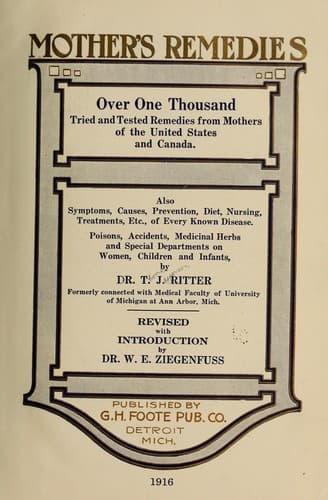
Mother's Remedies: Over One Thousand Tried and Tested Remedies from Mothers of the United States and CanadaRitter, Thomas Jefferson
Science
Mother's Remedies: Over One Thousand Tried and Tested Remedies from Mothers of the United States and Canada
Ritter, Thomas Jefferson
Etiquette; Formulas, recipes, etc.; Medicine, Popular
When the patient comes for treatment the fourteenth and thirteenth-day
cords are used for the first inoculation, and on each successive day the
patient receives inoculation, the strength of which has been regulated by
the number of days the cord has been hanging. During the first four days
patients receive injections of six cubic centimeters of emulsions made
from cords aging from fourteen to seven days, and from the fifth day until
the completion of the course of treatment patients receive emulsions from
cords of higher immunizing properties, but no cords desiccated for less
than four days are used.
[INFECTIOUS DISEASES 247]
Death rate from 1878-1883 before Pasteur treatment was instituted taken
from documents in the department of the Seine:
1878 143 bitten. 24 deaths.
1879 76 " 12 "
1880 68 " 5 "
1881 156 " 22 "
1882 67 " 11 "
1883 45 " 6 "
Average of one death to every six bitten, or seventeen per cent mortality.
Incubation period from eleven days to thirteen months, average one hundred
and twenty days, depending upon location of bite. Pasteur Institute
records during the years 1886-1887 and first half of 1888, show that
Pasteur had under his supervision 5,374 persons bitten by animals either
proven or thought to have been mad. Mortality for 1886 was 1-34 per cent,
during 1887 it was 1-12 per cent, during 1888 it was 77/100 per cent. With
the later treatment the mortality has decreased to 3-10 per cent in 1908.
The Pasteur method of treatment is a process of immunization which must be
completed before the development of the disease. It is of no value after
the symptoms have appeared.
Public-domain text, read in full here on John Shaqi.
Reviews
Reviews
No reviews yet
Be the first to share your thoughts on this work.
Elsewhere in the archive
Join the Discussion
Join the discussion
Sign in to leave a comment or review.
Sign InorCreate an account