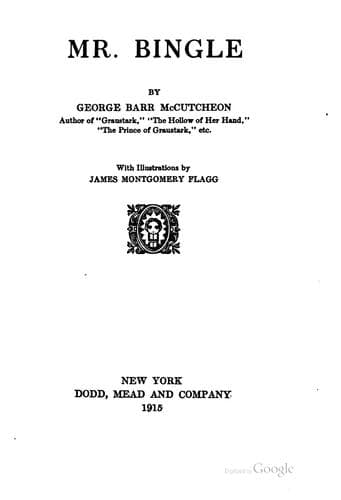
Christmas stories; Dickens, Charles, 1812-1870. Christmas carol -- Fiction; New York (N.Y.) -- Fiction
"The Supreme Court has finally handed down its decision in the case of
Hooper et al. vs. Bingle. I am not the rightful heir. Joseph H. Hooper
was not acting within his rights when he disposed of his privately
acquired fortune. His children were acting within their rights when
they disowned him, scorned him, kicked him out of their lives. It has
been decided that my uncle was not competent to dispose of his
property, and that I, his conniving nephew, influenced him by craft,
wiliness, duplicity and so forth to such an extent that he gave his
money to me instead of to those who should have received it. The
Supreme Court declares that all of the lower courts erred in not
admitting testimony to prove that my uncle DESIRED to leave his fortune
to his children, even after he had made his last will in my favour.
"It may interest you to know that 'The Christmas Carol' had a great
deal to do with the decision. The lower courts refused to hear evidence
to the effect that after making his will he wrote a letter to each of
his children, over his own signature, in which he stated that upon
reading the carol he was so impressed with the sermon it preached that
he was more than willing to let bygones be bygones and to give to his
children all of his fortune, in equal shares, expressing the hope,
however, that they would be governed by the same noble book in
compensating his beloved nephew, Thomas Bingle, and so on and so forth.
If they would take him back into their lives, he would forget and
forgive. Of course, no attention was paid to these letters at the time,
because he was supposed to be penniless. They only went to show that he
was mentally unbalanced. In the original trials, these letters were
introduced. The Christmas Carol was also offered as one of the
exhibits, and it was allowed to stick. When the story was read in open
court, every one sniffled, even the judge. The jury almost bellowed.
'As it was allowed to remain in the record, I've no doubt the Supreme
Bench wept a little over Tiny Tim. In its decision the Supreme Court
refers quite freely to the story and its effect on the old gentleman. I
shall not go into the history of the case. It would not be of interest
to you. It is only necessary for me to repeat that I shall be
penniless. Seawood must be turned over to the rightful owners. I don't
mind admitting that I have never really felt that it belonged to me. I
have always thought that Joseph Hooper's millions belonged to his
children, mean as they are.
Public-domain text, read in full here on John Shaqi.
Reviews
Reviews
No reviews yet
Be the first to share your thoughts on this work.
Elsewhere in the archive
Join the Discussion
Join the discussion
Sign in to leave a comment or review.
Sign InorCreate an account