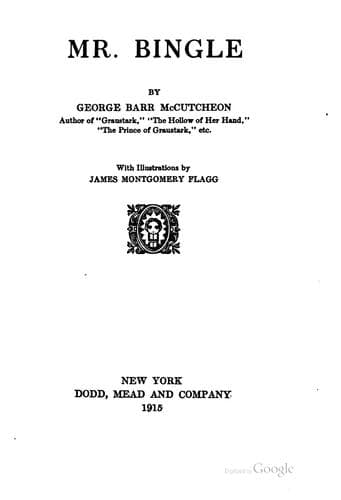
Christmas stories; Dickens, Charles, 1812-1870. Christmas carol -- Fiction; New York (N.Y.) -- Fiction
The proverbial church-mouse was no worse off than Mr. Bingle at the end
of the fifth month of his reduction. Indeed, it is more than probable
that the church-mouse would be conceded a distinct advantage in many
particulars. A very small nest will accommodate a very large family of
growing mice; the tighter they are packed in the nest the better off
they are in zero weather. Moreover, in a pinch, the parental
church-mouse may stave off famine by resorting to a cannibalistic plan
of economy, thereby saving its young the trouble of growing up to
become proverbial church-mice. It may devour its young when it becomes
painfully hungry, and not be held accountable to the law. With
commendable frugality, the church-mouse first eats off the tail of its
offspring. Then, if luck continues to be bad, the remainder may be
despatched with due and honest respect for the laws of nature.
Now, with Mr. Bingle, it was quite out of the question for him to
devour even so small a morsel as Napoleon without getting into serious
trouble with the law, and it was equally impossible to obtain the same
degree of comfort for his young by packing them into a four room flat.
And then the church-mouse doesn't have to think about shoes and
stockings and mittens and ear-muffs, to say nothing of frocks and
knickerbockers. So he who speaks of another as being "as poor as a
church-mouse" does a grave injustice to a really prosperous creature,
despite the fact that it lives in a church and is employed in the
rather dubious occupation of supporting a figure of speech. Look
carefully into the present law of economics, if you please, and then
grant the church-mouse the benefit of the doubt.
Mr. Bingle's flat could be found by traversing a very mean street in
the lower east side not far removed from the Third Avenue Elevated
tracks. Discovery required the mounting of four flights of stairs by
foot, and two turns to the right in following the course of the narrow,
dark hallway which led in a round-about sort of way to a fire escape
that invited a quicker and less painful death than destruction by
flames in case one had to choose between the two means of perishing.
Four rooms and a kitchen was all that Mr. Bingle's flat amounted to.
The four rooms contained beds; in the kitchen there was a collapsible
cot. In one of the rooms (ordinarily it would have been the parlour),
there was a somewhat futile sheet-iron stove in which soft coal or wood
could be used provided the wind was in the right direction. This was,
in fact, the parlour. The bed, by day, assumed the dignity of a broad
but saggy lounge, exceedingly comfortable if one was careful to sit far
enough forward to avoid slipping into its cavernous depths from which
there was no escape without assistance. Besides being the parlour, it
was also the library, the study-room, the dining-room and reception
hall. By night, it was the bed-chamber of Mr. Bingle.
Public-domain text, read in full here on John Shaqi.
Reviews
Reviews
No reviews yet
Be the first to share your thoughts on this work.
Elsewhere in the archive
Join the Discussion
Join the discussion
Sign in to leave a comment or review.
Sign InorCreate an account