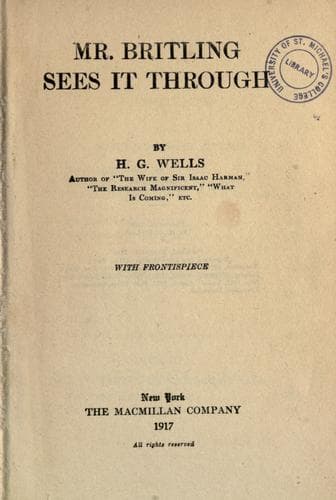
Mr. Britling Sees It ThroughWells, H. G. (Herbert George)
General
Mr. Britling Sees It Through
Wells, H. G. (Herbert George)
War stories; World War, 1914-1918 -- Fiction
"Mark my words," said Aunt Wilshire in her most impressive tones. "He is
insane. It will be proved to be so. He will end his days in an
asylum--as a lunatic. I have felt it myself for years and said so in
private.... Knowing what I did.... To such friends as I could trust not
to misunderstand me.... Now at least I can speak out.
"With his moustaches turned up!" exclaimed Aunt Wilshire after an
interval of accumulation.... "They say he has completely lost the use of
the joint in his left arm, he carries it stiff like a Punch and
Judy--and he wants to conquer Europe.... While his grandmother lived
there was some one to keep him in order. He stood in Awe of her. He
hated her, but he did not dare defy her. Even his uncle had some
influence. Now, nothing restrains him.
"A double-headed mad dog," said Aunt Wilshire. "Him and his eagles!... A
man like that ought never to have been allowed to make a war.... Not
even a little war.... If he had been put under restraint when I said so,
none of these things would have happened. But, of course I am nobody....
It was not considered worth attending to."
Section 10
One remarkable aspect of the English attitude towards the war was the
disposition to treat it as a monstrous joke. It is a disposition
traceable in a vast proportion of the British literature of the time. In
spite of violence, cruelty, injustice, and the vast destruction and
still vaster dangers of the struggles, that disposition held. The
English mind refused flatly to see anything magnificent or terrible in
the German attack, or to regard the German Emperor or the Crown Prince
as anything more than figures of fun. From first to last their
conception of the enemy was an overstrenuous, foolish man, red with
effort, with protruding eyes and a forced frightfulness of demeanour.
That he might be tremendously lethal did not in the least obscure the
fact that he was essentially ridiculous. And if as the war went on the
joke grew grimmer, still it remained a joke. The German might make a
desert of the world; that could not alter the British conviction that he
was making a fool of himself.
And this disposition kept coming to the surface throughout the
afternoon, now in a casual allusion, now in some deliberate jest. The
small boys had discovered the goose step, and it filled their little
souls with amazement and delight. That human beings should consent to
those ridiculous paces seemed to them almost incredibly funny. They
tried it themselves, and then set out upon a goose-step propaganda.
Letty and Cissie had come up to the Dower House for tea and news, and
they were enrolled with Teddy and Hugh. The six of them, chuckling and
swaying, marched, in vast scissor strides across the lawn. "Left," cried
Hugh. "Left."
"Toes _out_ more," said Mr. Lawrence Carmine.
"Keep stiffer," said the youngest Britling.
"Watch the Zeppelins and look proud," said Hugh. "With the chest out.
_Zo!_"
Public-domain text, read in full here on John Shaqi.
Reviews
Reviews
No reviews yet
Be the first to share your thoughts on this work.
Elsewhere in the archive
Join the Discussion
Join the discussion
Sign in to leave a comment or review.
Sign InorCreate an account