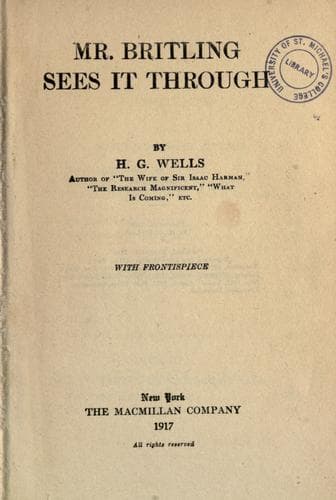
Mr. Britling Sees It ThroughWells, H. G. (Herbert George)
General
Mr. Britling Sees It Through
Wells, H. G. (Herbert George)
War stories; World War, 1914-1918 -- Fiction
This story is essentially the history of the opening and of the
realisation of the Great War as it happened to one small group of people
in Essex, and more particularly as it happened to one human brain. It
came at first to all these people in a spectacular manner, as a thing
happening dramatically and internationally, as a show, as something in
the newspapers, something in the character of an historical epoch rather
than a personal experience; only by slow degrees did it and its
consequences invade the common texture of English life. If this story
could be represented by sketches or pictures the central figure would be
Mr. Britling, now sitting at his desk by day or by night and writing
first at his tract "And Now War Ends" and then at other things, now
walking about his garden or in Claverings park or going to and fro in
London, in his club reading the ticker or in his hall reading the
newspaper, with ideas and impressions continually clustering, expanding,
developing more and more abundantly in his mind, arranging themselves,
reacting upon one another, building themselves into generalisations and
conclusions....
All Mr. Britling's mental existence was soon threaded on the war. His
more or less weekly _Times_ leader became dissertations upon the German
point of view; his reviews of books and Literary Supplement articles
were all oriented more and more exactly to that one supreme fact....
It was rare that he really seemed to be seeing the war; few people saw
it; for most of the world it came as an illimitable multitude of
incoherent, loud, and confusing impressions. But all the time he was at
least doing his utmost to see the war, to simplify it and extract the
essence of it until it could be apprehended as something epic and
explicable, as a stateable issue....
Most typical picture of all would be Mr. Britling writing in a little
circle of orange lamplight, with the blinds of his room open for the
sake of the moonlight, but the window shut to keep out the moths that
beat against it. Outside would be the moon and the high summer sky and
the old church tower dim above the black trees half a mile away, with
its clock--which Mr. Britling heard at night but never noted by
day--beating its way round the slow semicircle of the nocturnal hours.
He had always hated conflict and destruction, and felt that war between
civilised states was the quintessential expression of human failure, it
was a stupidity that stopped progress and all the free variation of
humanity, a thousand times he had declared it impossible, but even now
with his country fighting he was still far from realising that this was
a thing that could possibly touch him more than intellectually. He did
not really believe with his eyes and finger-tips and backbone that
murder, destruction, and agony on a scale monstrous beyond precedent was
going on in the same world as that which slumbered outside the black ivy
and silver shining window-sill that framed his peaceful view.
Public-domain text, read in full here on John Shaqi.
Reviews
Reviews
No reviews yet
Be the first to share your thoughts on this work.
Elsewhere in the archive
Join the Discussion
Join the discussion
Sign in to leave a comment or review.
Sign InorCreate an account