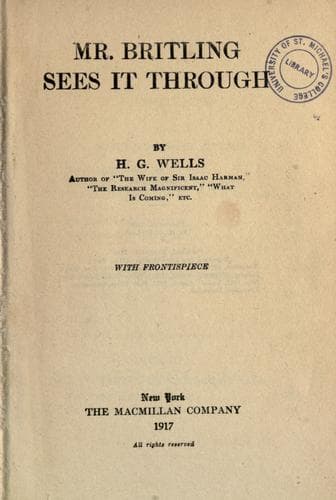
Mr. Britling Sees It ThroughWells, H. G. (Herbert George)
General
Mr. Britling Sees It Through
Wells, H. G. (Herbert George)
War stories; World War, 1914-1918 -- Fiction
He was parting very reluctantly from his dream of a disastrous collapse
of German imperialism, of a tremendous, decisive demonstration of the
inherent unsoundness of militarist monarchy, to be followed by a world
conference of chastened but hopeful nations, and--the Millennium. He
tried now to think that Mr. Direck had observed badly and misconceived
what he saw. An American, unused to any sort of military occurrences,
might easily mistake tens of thousands for millions, and the excitement
of a few commercial travellers for the enthusiasm of a united people.
But the newspapers now, with a kindred reluctance, were beginning to
qualify, bit by bit, their first representation of the German attack
through Belgium as a vast and already partly thwarted parade of
incompetence. The Germans, he gathered, were being continually beaten in
Belgium; but just as continually they advanced. Each fresh newspaper
name he looked up on the map marked an oncoming tide. Alost--Charleroi.
Farther east the French were retreating from the Saales Pass. Surely the
British, who had now been in France for a fortnight, would presently be
manifest, stemming the onrush; somewhere perhaps in Brabant or East
Flanders. It gave Mr. Britling an unpleasant night to hear at Claverings
that the French were very ill-equipped; had no good modern guns either
at Lille or Maubeuge, were short of boots and equipment generally, and
rather depressed already at the trend of things. Mr. Britling dismissed
this as pessimistic talk, and built his hopes on the still invisible
British army, hovering somewhere--
He would sit over the map of Belgium, choosing where he would prefer to
have the British hover....
Namur fell. The place names continued to shift southward and westward.
The British army or a part of it came to light abruptly at Mons. It had
been fighting for thirty-eight hours and defeating enormously superior
forces of the enemy. That was reassuring until a day or so later "the
Cambray--Le Cateau line" made Mr. Britling realise that the victorious
British had recoiled five and twenty miles....
And then came the Sunday of _The Times_ telegram, which spoke of a
"retreating and a broken army." Mr. Britling did not see this, but Mr.
Manning brought over the report of it in a state of profound
consternation. Things, he said, seemed to be about as bad as they could
be. The English were retreating towards the coast and in much disorder.
They were "in the air" and already separated from the Trench. They had
narrowly escaped "a Sedan" under the fortifications of Maubeuge.... Mr.
Britling was stunned. He went to his study and stared helplessly at
maps. It was as if David had flung his pebble--and missed!
Public-domain text, read in full here on John Shaqi.
Reviews
Reviews
No reviews yet
Be the first to share your thoughts on this work.
Elsewhere in the archive
Join the Discussion
Join the discussion
Sign in to leave a comment or review.
Sign InorCreate an account