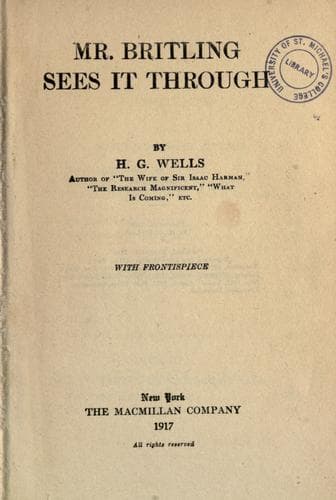
Mr. Britling Sees It ThroughWells, H. G. (Herbert George)
General
Mr. Britling Sees It Through
Wells, H. G. (Herbert George)
War stories; World War, 1914-1918 -- Fiction
"It's only for the duration of the war," said Teddy. "And Letty's very
intelligent. I've done my best to chasten the evil in her."
"If you think you're going to get back your job after the war," said
Letty, "you're very much mistaken. I'm going to raise the standard."
"_You_!" said Teddy, regarding her coldly, and proceeded ostentatiously
to talk of other things.
Section 6
"Hugh's going to be in khaki too," the elder junior told Teddy. "He's
too young to go out in Kitchener's army, but he's joined the
Territorials. He went off on Thursday.... I wish Gilbert and me was
older...."
Mr. Britling had known his son's purpose since the evening of Teddy's
announcement.
Hugh had come to his father's study as he was sitting musing at his
writing-desk over the important question whether he should continue his
"Examination of War" uninterruptedly, or whether he should not put that
on one side for a time and set himself to state as clearly as possible
the not too generally recognised misfit between the will and strength of
Britain on the one hand and her administrative and military organisation
on the other. He felt that an enormous amount of human enthusiasm and
energy was being refused and wasted; that if things went on as they were
going there would continue to be a quite disastrous shortage of gear,
and that some broadening change was needed immediately if the swift
exemplary victory over Germany that his soul demanded was to be ensured.
Suppose he were to write some noisy articles at once, an article, for
instance, to be called "The War of the Mechanics" or "The War of Gear,"
and another on "Without Civil Strength there is no Victory." If he wrote
such things would they be noted or would they just vanish
indistinguishably into the general mental tumult? Would they be audible
and helpful shouts, or just waste of shouting?... That at least was what
he supposed himself to be thinking; it was, at any rate, the main
current of his thinking; but all the same, just outside the circle of
his attention a number of other things were dimly apprehended, bobbing
up and down in the flood and ready at the slightest chance to swirl into
the centre of his thoughts. There was, for instance, Captain Carmine in
the moonlight lugging up a railway embankment something horrible,
something loose and wet and warm that had very recently been a man.
There was Teddy, serious and patriotic--filling a futile penman with
incredulous respect. There was the thin-faced man at the club, and a
curious satisfaction he had betrayed in the public disarrangement. And
there was Hugh. Particularly there was Hugh, silent but watchful. The
boy never babbled. He had his mother's gift of deep dark silences. Out
of which she was wont to flash, a Black Princess waving a sword. He
wandered for a little while among memories.... But Hugh didn't come out
like that, though it always seemed possible he might--perhaps he didn't
come out because he was a son. Revelation to his father wasn't his
Public-domain text, read in full here on John Shaqi.
Reviews
Reviews
No reviews yet
Be the first to share your thoughts on this work.
Elsewhere in the archive
Join the Discussion
Join the discussion
Sign in to leave a comment or review.
Sign InorCreate an account