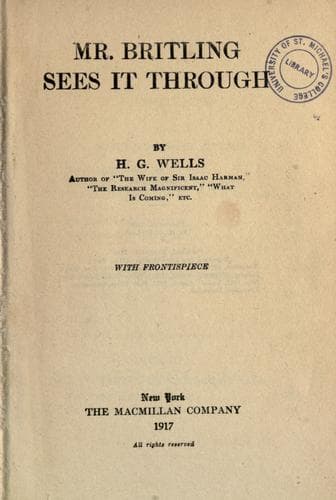
Mr. Britling Sees It ThroughWells, H. G. (Herbert George)
General
Mr. Britling Sees It Through
Wells, H. G. (Herbert George)
War stories; World War, 1914-1918 -- Fiction
Mr. Van der Pant had not the extreme tactfulness of his so typically
Catholic wife; he made it only too plain that he thought the British
postal and telegraph service slow and slack, and the management of the
Great Eastern branch lines wasteful and inefficient. He said the workmen
in the fields and the workmen he saw upon some cottages near the
junction worked slowlier and with less interest than he had ever seen
any workman display in all his life before. He marvelled that Mr.
Britling lit his house with acetylene and not electric light. He thought
fresh eggs were insanely dear, and his opinion of Matching's Easy
pig-keeping was uncomplimentary. The roads, he said, were not a means of
getting from place to place, they were a _dédale_; he drew derisive maps
with his finger on the table-cloth of the lane system about the Dower
House. He was astonished that there was no Café in Matching's Easy; he
declared that the "public house" to which he went with considerable
expectation was no public house at all; it was just a sly place for
drinking beer.... All these were things Mr. Britling might have remarked
himself; from a Belgian refugee he found them intolerable.
He set himself to explain to Mr. Van der Pant firstly that these things
did not matter in the slightest degree, the national attention, the
national interest ran in other directions; and secondly that they were,
as a matter of fact and on the whole, merits slightly disguised. He
produced a pleasant theory that England is really not the Englishman's
field, it is his breeding place, his resting place, a place not for
efficiency but good humour. If Mr. Van der Pant were to make inquiries
he would find there was scarcely a home in Matching's Easy that had not
sent some energetic representative out of England to become one of the
English of the world. England was the last place in which English energy
was spent. These hedges, these dilatory roads were full of associations.
There was a road that turned aside near Market Saffron to avoid Turk's
wood; it had been called Turk's wood first in the fourteenth century
after a man of that name. He quoted Chesterton's happy verses to justify
these winding lanes.
"The road turned first towards the left,
Where Perkin's quarry made the cleft;
The path turned next towards the right,
Because the mastiff used to bite...."
And again:
"And I should say they wound about
To find the town of Roundabout,
The merry town of Roundabout
That makes the world go round."
If our easy-going ways hampered a hard efficiency, they did at least
develop humour and humanity. Our diplomacy at any rate had not failed
us....
He did not believe a word of this stuff. His deep irrational love for
England made him say these things.... For years he had been getting
himself into hot water because he had been writing and hinting just such
criticisms as Mr. Van der Pant expressed so bluntly.... But he wasn't
going to accept foreign help in dissecting his mother....
Public-domain text, read in full here on John Shaqi.
Reviews
Reviews
No reviews yet
Be the first to share your thoughts on this work.
Elsewhere in the archive
Join the Discussion
Join the discussion
Sign in to leave a comment or review.
Sign InorCreate an account