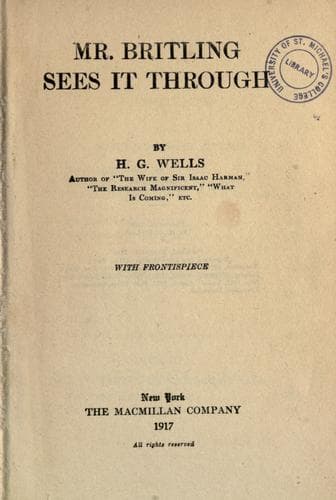
Mr. Britling Sees It ThroughWells, H. G. (Herbert George)
General
Mr. Britling Sees It Through
Wells, H. G. (Herbert George)
War stories; World War, 1914-1918 -- Fiction
Notably he would not recognise at first the extreme bitterness of this
war. He would not believe that the attack upon Britain and Western
Europe generally expressed the concentrated emotion of a whole nation.
He thought that the Allies were in conflict with a system and not with a
national will. He fought against the persuasion that the whole mass of a
great civilised nation could be inspired by a genuine and sustained
hatred. Hostility was an uncongenial thing to him; he would not
recognise that the greater proportion of human beings are more readily
hostile than friendly. He did his best to believe--in his "And Now War
Ends" he did his best to make other people believe--that this war was
the perverse exploit of a small group of people, of limited but powerful
influences, an outrage upon the general geniality of mankind. The
cruelty, mischief, and futility of war were so obvious to him that he
was almost apologetic in asserting them. He believed that war had but to
begin and demonstrate its quality among the Western nations in order to
unify them all against its repetition. They would exclaim: "But we can't
do things like this to one another!" He saw the aggressive imperialism
of Germany called to account even by its own people; a struggle, a
collapse, a liberal-minded conference of world powers, and a universal
resumption of amiability upon a more assured basis of security. He
believed--and many people in England believed with him--that a great
section of the Germans would welcome triumphant Allies as their
liberators from intolerable political obsessions.
The English because of their insularity had been political amateurs for
endless generations. It was their supreme vice, it was their supreme
virtue, to be easy-going. They had lived in an atmosphere of comedy, and
denied in the whole tenor of their lives that life is tragic. Not even
the Americans had been more isolated. The Americans had had their
Indians, their negroes, their War of Secession. Until the Great War the
Channel was as broad as the Atlantic for holding off every vital
challenge. Even Ireland was away--a four-hour crossing. And so the
English had developed to the fullest extent the virtues and vices of
safety and comfort; they had a hatred of science and dramatic behaviour;
they could see no reason for exactness or intensity; they disliked
proceeding "to extremes." Ultimately everything would turn out all
right. But they knew what it is to be carried into conflicts by
energetic minorities and the trick of circumstances, and they were ready
to understand the case of any other country which has suffered that
fate. All their habits inclined them to fight good-temperedly and
comfortably, to quarrel with a government and not with a people. It took
Mr. Britling at least a couple of months of warfare to understand that
the Germans were fighting in an altogether different spirit.
Public-domain text, read in full here on John Shaqi.
Reviews
Reviews
No reviews yet
Be the first to share your thoughts on this work.
Elsewhere in the archive
Join the Discussion
Join the discussion
Sign in to leave a comment or review.
Sign InorCreate an account