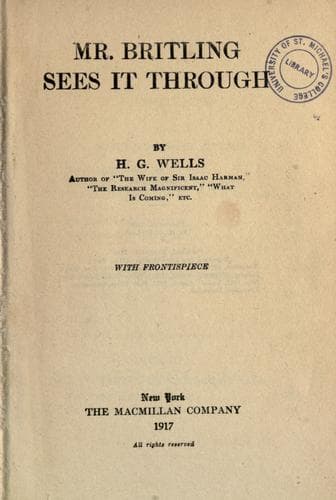
Mr. Britling Sees It ThroughWells, H. G. (Herbert George)
General
Mr. Britling Sees It Through
Wells, H. G. (Herbert George)
War stories; World War, 1914-1918 -- Fiction
Mr. Britling would sit in his armchair and stare at his fire, and recall
conflicting memories of Germany--of a pleasant land, of friendly people.
He had spent many a jolly holiday there. So recently as 1911 all the
Britling family had gone up the Rhine from Rotterdam, had visited a
string of great cities and stayed for a cheerful month of sunshine at
Neunkirchen in the Odenwald.
The little village perches high among the hills and woods, and at its
very centre is the inn and the linden tree and--Adam Meyer. Or at least
Adam Meyer _was_ there. Whether he is there now, only the spirit of
change can tell; if he live to be a hundred no friendly English will
ever again come tramping along by the track of the Blaue Breiecke or the
Weisse Streiche to enjoy his hospitality; there are rivers of blood
between, and a thousand memories of hate....
It was a village distended with hospitalities. Not only the inn but all
the houses about the place of the linden tree, the shoe-maker's, the
post-mistress's, the white house beyond, every house indeed except the
pastor's house, were full of Adam Meyer's summer guests. And about it
and over it went and soared Adam Meyer, seeing they ate well, seeing
they rested well, seeing they had music and did not miss the
moonlight--a host who forgot profit in hospitality, an inn-keeper with
the passion of an artist for his inn.
Music, moonlight, the simple German sentiment, the hearty German voices,
the great picnic in a Stuhl Wagen, the orderly round games the boys
played with the German children, and the tramps and confidences Hugh had
with Kurt and Karl, and at last a crowning jollification, a dance, with
some gipsy musicians whom Mr. Britling discovered, when the Germans
taught the English various entertaining sports with baskets and potatoes
and forfeits and the English introduced the Germans to the licence of
the two-step. And everybody sang "Britannia, Rule the Waves," and
"Deutschland, Deutschland über Alles," and Adam Meyer got on a chair and
made a tremendous speech more in dialect than ever, and there was much
drinking of beer and sirops in the moonlight under the linden....
Afterwards there had been a periodic sending of postcards and greetings,
which indeed only the war had ended.
Public-domain text, read in full here on John Shaqi.
Reviews
Reviews
No reviews yet
Be the first to share your thoughts on this work.
Elsewhere in the archive
Join the Discussion
Join the discussion
Sign in to leave a comment or review.
Sign InorCreate an account