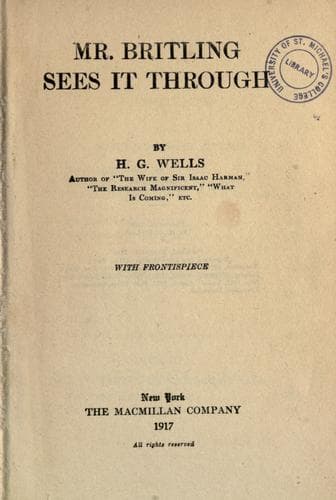
Mr. Britling Sees It ThroughWells, H. G. (Herbert George)
General
Mr. Britling Sees It Through
Wells, H. G. (Herbert George)
War stories; World War, 1914-1918 -- Fiction
It will be an incredible thing to the happier reader of a coming age--if
ever this poor record of experience reaches a reader in the days to
come--to learn how much of the mental life of Mr. Britling was occupied
at this time with the mere horror and atrocity of warfare. It is idle
and hopeless to speculate now how that future reader will envisage this
war; it may take on broad dramatic outlines, it may seem a thing, just,
logical, necessary, the burning of many barriers, the destruction of
many obstacles. Mr. Britling was too near to the dirt and pain and heat
for any such broad landscape consolations. Every day some new detail of
evil beat into his mind. Now it would be the artless story of some
Belgian refugee. There was a girl from Alost in the village for example,
who had heard the fusillade that meant the shooting of citizens, the
shooting of people she had known, she had seen the still blood-stained
wall against which two murdered cousins had died, the streaked sand
along which their bodies had been dragged; three German soldiers had
been quartered in her house with her and her invalid mother, and had
talked freely of the massacres in which they had been employed. One of
them was in civil life a young schoolmaster, and he had had, he said, to
kill a woman and a baby. The girl had been incredulous. Yes, he had done
so! Of course he had done so! His officer had made him do it, had stood
over him. He could do nothing but obey. But since then he had been
unable to sleep, unable to forget.
"We had to punish the people," he said. "They had fired on us."
And besides, his officer had been drunk. It had been impossible to
argue. His officer had an unrelenting character at all times....
Over and over again Mr. Britling would try to imagine that young
schoolmaster soldier at Alost. He imagined with a weak staring face and
watery blue eyes behind his glasses, and that memory of murder....
Then again it would be some incident of death and mutilation in Antwerp,
that Van der Pant described to him. The Germans in Belgium were shooting
women frequently, not simply for grave spying but for trivial
offences.... Then came the battleship raid on Whitby and Scarborough,
and the killing among other victims of a number of children on their way
to school. This shocked Mr. Britling absurdly, much more than the
Belgian crimes had done. They were _English_ children. At home!... The
drowning of a great number of people on a torpedoed ship full of
refugees from Flanders filled his mind with pitiful imaginings for days.
The Zeppelin raids, with their slow crescendo of blood-stained futility,
began before the end of 1914.... It was small consolation for Mr.
Britling to reflect that English homes and women and children were,
after all, undergoing only the same kind of experience that our ships
have inflicted scores of times in the past upon innocent people in the
villages of Africa and Polynesia....
Public-domain text, read in full here on John Shaqi.
Reviews
Reviews
No reviews yet
Be the first to share your thoughts on this work.
Elsewhere in the archive
Join the Discussion
Join the discussion
Sign in to leave a comment or review.
Sign InorCreate an account