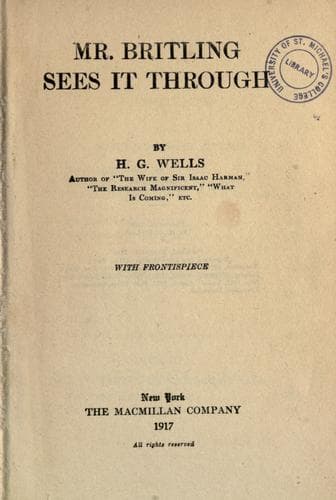
Mr. Britling Sees It ThroughWells, H. G. (Herbert George)
General
Mr. Britling Sees It Through
Wells, H. G. (Herbert George)
War stories; World War, 1914-1918 -- Fiction
Too long had British life been corrupted by the fictions of loyalty to
an uninspiring and alien Court, of national piety in an official Church,
of freedom in a politician-rigged State, of justice in an economic
system where the advertiser, the sweater and usurer had a hundred
advantages over the producer and artisan, to maintain itself now
steadily at any high pitch of heroic endeavour. It had bought its
comfort with the demoralisation of its servants. It had no completely
honest organs; its spirit was clogged by its accumulated insincerities.
Brought at last face to face with a bitter hostility and a powerful and
unscrupulous enemy, an enemy socialistic, scientific and efficient to an
unexampled degree, it seemed indeed to be inspired for a time by an
unwonted energy and unanimity. Youth and the common people shone. The
sons of every class went out to fight and die, full of a splendid dream
of this war. Easy-going vanished from the foreground of the picture. But
only to creep back again as the first inspiration passed. Presently the
older men, the seasoned politicians, the owners and hucksters, the
charming women and the habitual consumers, began to recover from this
blaze of moral exaltation. Old habits of mind and procedure reasserted
themselves. The war which had begun so dramatically missed its climax;
there was neither heroic swift defeat nor heroic swift victory. There
was indecision; the most trying test of all for an undisciplined people.
There were great spaces of uneventful fatigue. Before the Battle of the
Yser had fully developed the dramatic quality had gone out of the war.
It had ceased to be either a tragedy or a triumph; for both sides it
became a monstrous strain and wasting. It had become a wearisome
thrusting against a pressure of evils....
Under that strain the dignity of England broke, and revealed a malignity
less focussed and intense than the German, but perhaps even more
distressing. No paternal government had organised the British spirit for
patriotic ends; it became now peevish and impatient, like some
ill-trained man who is sick, it directed itself no longer against the
enemy alone but fitfully against imagined traitors and shirkers; it
wasted its energies in a deepening and spreading net of internal
squabbles and accusations. Now it was the wily indolence of the Prime
Minister, now it was the German culture of the Lord Chancellor, now the
imaginative enterprise of the First Lord of the Admiralty that focussed
a vindictive campaign. There began a hunt for spies and of suspects of
German origin in every quarter except the highest; a denunciation now of
"traitors," now of people with imaginations, now of scientific men, now
of the personal friend of the Commander-in-Chief, now of this group and
then of that group.... Every day Mr. Britling read his three or four
newspapers with a deepening disappointment.
When he turned from the newspaper to his post, he would find the
anonymous letter-writer had been busy....
Public-domain text, read in full here on John Shaqi.
Reviews
Reviews
No reviews yet
Be the first to share your thoughts on this work.
Elsewhere in the archive
Join the Discussion
Join the discussion
Sign in to leave a comment or review.
Sign InorCreate an account