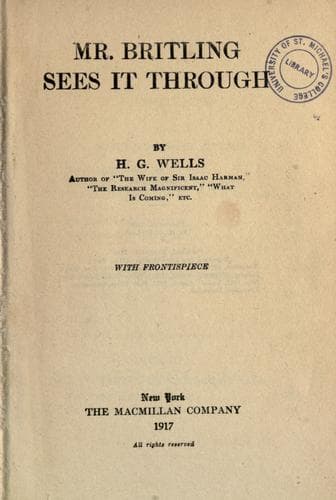
Mr. Britling Sees It ThroughWells, H. G. (Herbert George)
General
Mr. Britling Sees It Through
Wells, H. G. (Herbert George)
War stories; World War, 1914-1918 -- Fiction
In spite of his detestation of war Mr. Britling found it impossible to
maintain that any sort of peace state was better than a state of war. If
wars produced destructions and cruelties, peace could produce indolence,
perversity, greedy accumulation and selfish indulgences. War is
discipline for evil, but peace may be relaxation from good. The poor man
may be as wretched in peace time as in war time. The gathering forces of
an evil peace, the malignity and waste of war, are but obverse and
reverse of the medal of ill-adjusted human relationships. Was there no
Greater Peace possible; not a mere recuperative pause in killing and
destruction, but a phase of noble and creative living, a phase of
building, of discovery, of beauty and research? He remembered, as one
remembers the dead, dreams he had once dreamt of the great cities, the
splendid freedoms, of a coming age, of marvellous enlargements of human
faculty, of a coming science that would be light and of art that could
be power....
But would that former peace have ever risen to that?...
After all, had such visions ever been more than idle dreams? Had the war
done more than unmask reality?...
He came to a gate and leant over it.
The darkness drizzled about him; he turned up his collar and watched the
dim shapes of trees and hedges gather out of the night to meet the
dismal dawn. He was cold and hungry and weary.
He may have drowsed; at least he had a vision, very real and plain, a
vision very different from any dream of Utopia.
It seemed to him that suddenly a mine burst under a great ship at sea,
that men shouted and women sobbed and cowered, and flares played upon
the rain-pitted black waves; and then the picture changed and showed a
battle upon land, and searchlights were flickering through the rain and
shells flashed luridly, and men darkly seen in silhouette against red
flames ran with fixed bayonets and slipped and floundered over the mud,
and at last, shouting thinly through the wind, leapt down into the enemy
trenches....
And then he was alone again staring over a wet black field towards a dim
crest of shapeless trees.
Section 9
Abruptly and shockingly, this malignity of warfare, which had been so
far only a festering cluster of reports and stories and rumours and
suspicions, stretched out its arm into Essex and struck a barb of
grotesque cruelty into the very heart of Mr. Britling. Late one
afternoon came a telegram from Filmington-on-Sea, where Aunt Wilshire
had been recovering her temper in a boarding-house after a round of
visits in Yorkshire and the moorlands. And she had been "very seriously
injured" by an overnight German air raid. It was a raid that had not
been even mentioned in the morning's papers. She had asked to see him.
It was, ran the compressed telegraphic phrase, "advisable to come at
once."
Public-domain text, read in full here on John Shaqi.
Reviews
Reviews
No reviews yet
Be the first to share your thoughts on this work.
Elsewhere in the archive
Join the Discussion
Join the discussion
Sign in to leave a comment or review.
Sign InorCreate an account