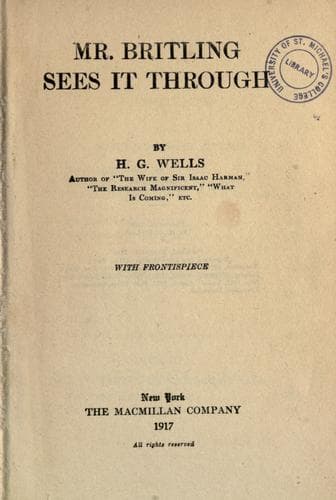
Mr. Britling Sees It ThroughWells, H. G. (Herbert George)
General
Mr. Britling Sees It Through
Wells, H. G. (Herbert George)
War stories; World War, 1914-1918 -- Fiction
Hugh's letters were becoming a very important influence upon Mr.
Britling's thought. Hugh had always been something of a letter-writer,
and now what was perhaps an inherited desire to set things down was
manifest. He had been accustomed to decorate his letters from school
with absurd little sketches--sometimes his letters had been all
sketches--and now he broke from drawing to writing and back to drawing
in a way that pleased his father mightily. The father loved this queer
trick of caricature; he did not possess it himself, and so it seemed to
him the most wonderful of all Hugh's little equipment of gifts. Mr.
Britling used to carry these letters about until their edges got grimy;
he would show them to any one he felt capable of appreciating their
youthful freshness; he would quote them as final and conclusive evidence
to establish this or that. He did not dream how many thousands of
mothers and fathers were treasuring such documents. He thought other
sons were dull young men by comparison with Hugh.
The earlier letters told much of the charms of discipline and the open
air. "All the bother about what one has to do with oneself is over,"
wrote Hugh. "One has disposed of oneself. That has the effect of a great
relief. Instead of telling oneself that one ought to get up in the
morning, a bugle tells you that.... And there's no nonsense about it, no
chance of lying and arguing about it with oneself.... I begin to see the
sense of men going into monasteries and putting themselves under rules.
One is carried along in a sort of moral automobile instead of trudging
the road...."
And he was also sounding new physical experiences.
"Never before," he declared, "have I known what fatigue is. It's a
miraculous thing. One drops down in one's clothes on any hard old thing
and sleeps...."
And in his early letters he was greatly exercised by the elementary
science of drill and discipline, and the discussion of whether these
things were necessary. He began by assuming that their importance was
overrated. He went on to discover that they constituted the very
essentials of all good soldiering. "In a crisis," he concluded, "there
is no telling what will get hold of a man, his higher instincts or his
lower. He may show courage of a very splendid sort--or a hasty
discretion. A habit is much more trustworthy than an instinct. So
discipline sets up a habit of steady and courageous bearing. If you keep
your head you are at liberty to be splendid. If you lose it, the habit
will carry you through."
The young man was also very profound upon the effects of the suggestion
of various exercises upon the mind.
"It is surprising how bloodthirsty one feels in a bayonet charge. We
have to shout; we are encouraged to shout. The effect is to paralyse
one's higher centres. One ceases to question--anything. One becomes a
'bayoneteer.' As I go bounding forward I imagine fat men, succulent men
ahead, and I am filled with the desire to do them in neatly. This sort
of thing--"
Public-domain text, read in full here on John Shaqi.
Reviews
Reviews
No reviews yet
Be the first to share your thoughts on this work.
Elsewhere in the archive
Join the Discussion
Join the discussion
Sign in to leave a comment or review.
Sign InorCreate an account