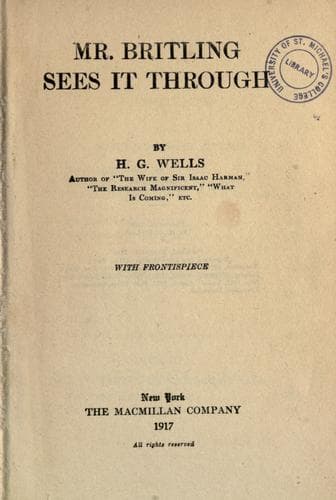
Mr. Britling Sees It ThroughWells, H. G. (Herbert George)
General
Mr. Britling Sees It Through
Wells, H. G. (Herbert George)
War stories; World War, 1914-1918 -- Fiction
Not all Hugh's letters were concerned with these grim technicalities. It
was not always that news and gossip came along; it was rare that a young
man with a commission would condescend to talk shop to two young men
without one; there were few newspapers and fewer maps, and even in
France and within sound of guns, Hugh could presently find warfare
almost as much a bore as it had been at times in England. But his
criticism of military methods died away. "Things are done better out
here," he remarked, and "We're nearer reality here. I begin to respect
my Captain. Who is developing a sense of locality. Happily for our
prospects." And in another place he speculated in an oddly
characteristic manner whether he was getting used to the army way,
whether he was beginning to see the sense of the army way, or whether
it really was that the army way braced up nearer and nearer to
efficiency as it got nearer to the enemy. "And here one hasn't the
haunting feeling that war is after all an hallucination. It's already
common sense and the business of life....
"In England I always had a sneaking idea that I had 'dressed up' in my
uniform....
"I never dreamt before I came here how much war is a business of waiting
about and going through duties and exercises that were only too
obviously a means of preventing our discovering just how much waiting
about we were doing. I suppose there is no great harm in describing the
place I am in here; it's a kind of scenery that is somehow all of a
piece with the life we lead day by day. It is a village that has been
only partly smashed up; it has never been fought through, indeed the
Germans were never within two miles of it, but it was shelled
intermittently for months before we made our advance. Almost all the
houses are still standing, but there is not a window left with a square
foot of glass in the place. One or two houses have been burnt out, and
one or two are just as though they had been kicked to pieces by a
lunatic giant. We sleep in batches of four or five on the floors of the
rooms; there are very few inhabitants about, but the village inn still
goes on. It has one poor weary billiard-table, very small with very big
balls, and the cues are without tops; it is The Amusement of the place.
Ortheris does miracles at it. When he leaves the army he says he's going
to be a marker, 'a b----y marker.' The country about us is
flat--featureless--desolate. How I long for hills, even for Essex mud
hills. Then the road runs on towards the front, a brick road frightfully
worn, lined with poplars. Just at the end of the village mechanical
transport ends and there is a kind of depot from which all the stuff
goes up by mules or men or bicycles to the trenches. It is the only
movement in the place, and I have spent hours watching men shift grub or
ammunition or lending them a hand. All day one hears guns, a kind of
thud at the stomach, and now and then one sees an aeroplane, very high
and small.
Public-domain text, read in full here on John Shaqi.
Reviews
Reviews
No reviews yet
Be the first to share your thoughts on this work.
Elsewhere in the archive
Join the Discussion
Join the discussion
Sign in to leave a comment or review.
Sign InorCreate an account