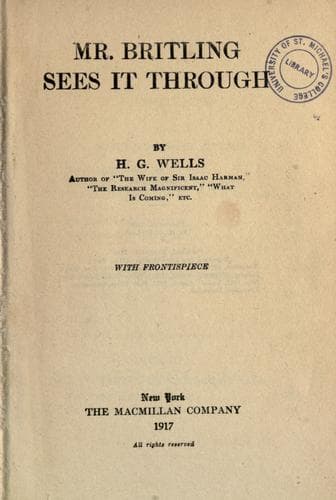
Mr. Britling Sees It ThroughWells, H. G. (Herbert George)
General
Mr. Britling Sees It Through
Wells, H. G. (Herbert George)
War stories; World War, 1914-1918 -- Fiction
"And now about those trenches--as I promised. The great thing to grasp
is that they are narrow. They are a sort of negative wall. They are more
like giant cracks in the ground than anything else.... But perhaps I had
better begin by telling how we got there. We started about one in the
morning ladened up with everything you can possibly imagine on a
soldier, and in addition I had a kettle--filled with water--most of the
chaps had bundles of firewood, and some had extra bread. We marched out
of our quarters along the road for a mile or more, and then we took the
fields, and presently came to a crest and dropped into a sort of maze of
zigzag trenches going up to the front trench. These trenches, you know,
are much deeper than one's height; you don't see anything. It's like
walking along a mud-walled passage. You just trudge along them in single
file. Every now and then some one stumbles into a soakaway for rainwater
or swears at a soft place, or somebody blunders into the man in front of
him. This seems to go on for hours and hours. It certainly went on for
an hour; so I suppose we did two or three miles of it. At one place we
crossed a dip in the ground and a ditch, and the trench was built up
with sandbags up to the ditch and there was a plank. Overhead there were
stars, and now and then a sort of blaze thing they send up lit up the
edges of the trench and gave one a glimpse of a treetop or a factory
roof far away. Then for a time it was more difficult to go on because
you were blinded. Suddenly just when you were believing that this sort
of trudge was going on forever, we were in the support trenches behind
the firing line, and found the men we were relieving ready to come
back.
"And the firing line itself? Just the same sort of ditch with a parapet
of sandbags, but with dug-outs, queer big holes helped out with sleepers
from a nearby railway track, opening into it from behind. Dug-outs vary
a good deal. Many are rather like the cubby-house we made at the end of
the orchard last summer; only the walls are thick enough to stand a high
explosive shell. The best dug-out in our company's bit of front was
quite a dressy affair with some woodwork and a door got from the ruins
of a house twenty or thirty yards behind us. It had a stove in it too,
and a chimbley, and pans to keep water in. It was the best dug-out for
miles. This house had a well, and there was a special trench ran back to
that, and all day long there was a coming and going for water. There had
once been a pump over the well, but a shell had smashed that....
Public-domain text, read in full here on John Shaqi.
Reviews
Reviews
No reviews yet
Be the first to share your thoughts on this work.
Elsewhere in the archive
Join the Discussion
Join the discussion
Sign in to leave a comment or review.
Sign InorCreate an account